
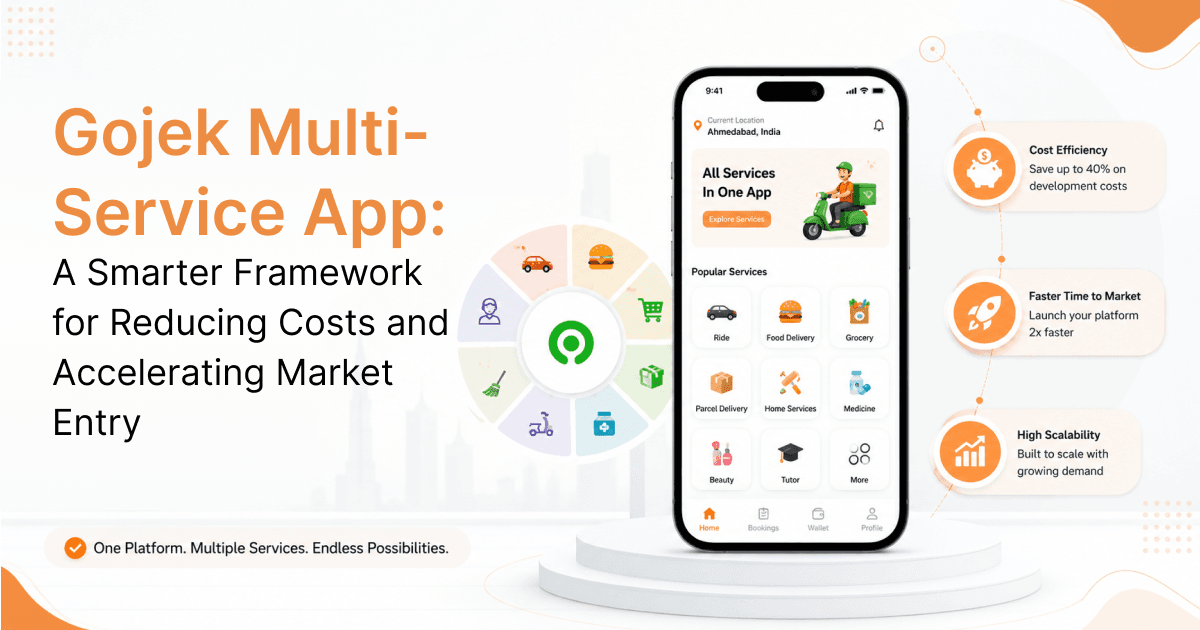

The on-demand app market just isn’t what it used to be. It is now a market with intense competition. Some startups launch single-service apps for one specific need, such as a taxi booking app, a food delivery app, or a home service app. But by doing this, they have to deal with increased customer acquisition costs (CAC), because they mainly depend on marketing campaigns to attract users for limited transactions.
The real problem is building long-term customer value. It is hard to grow lifetime value (LTV) if a user only opens an app occasionally. Companies have to find a way to engage them rather than spending on expensive marketing campaigns to attract users.
A Gojek Multi-Service App approach solves this by combining multiple services into one single platform. To improve customer engagement and create more transaction opportunities, businesses should build an ecosystem where users can access transportation services, delivery services, and other local services from a single application rather than a separate app for each use case.
Why Businesses Are Moving to Multi-Service Apps
The following are the reasons behind entrepreneurs shifting from a single-service model to ecosystem-based platforms:
- Multiple services increase user engagement and repeat usage
- One customer can generate revenue across different service categories
- Businesses reduce dependency on a single income source
A multi-service platform can include the following services:
- transportation services
- Food delivery services
- Grocery services
- Logistics services
- Digital payments
- Local services
It’s all about cross-selling. When customers use one service, they can easily discover other services as well, which keeps them engaged on our platform.
However, the cost of building such a multi-service platform is huge, and there are also several challenges, like huge development costs, management of infrastructure, maintenance of the platform, and delayed market launch of the business. The solution to this problem is a white-label framework that provides a faster way to test ideas, reduces development costs, and enables faster market entry.
Why a white-label solution reduces startup costs
Custom Development vs Pre-Built Platforms
The multi-service platform is not something that can be built easily. It requires enough time, heavy funds, and various technical resources to build a multi-service platform. Developing a custom platform requires months of planning, development, testing, and deployment before it is ready to launch in the market.
The following are multiple teams that a startup needs:
- Developers to develop a product
- QA teams for testing and quality control
- Product managers for planning and execution
- Infrastructure teams for hosting and scaling
A white-label framework changes this process by providing a ready-made solution. So there is no need to create every feature from scratch; businesses can customize it and launch into the market faster than custom development. It reduces the development cost and time compared to custom development, and allows entrepreneurs to focus more on customer requirements and market trends.
The Hidden Costs of Developing a Multi-Service App
It’s a common misconception that most custom development costs are at the initial expense of coding, but that’s simply not true. The real custom development cost goes beyond it; it also includes backend architecture costs, server expenses, security costs, and maintenance costs.
As user activity grows, server infrastructure becomes more complex. A platform handling multiple services, similar to a Gojek multi-service app, needs reliable systems for payments, bookings, tracking, and user data management.
Long-term costs include:
- Backend improvements and bug fixes
- Security maintenance
- Feature upgrades
- Clean messy code base
These expenses can slow business growth, and for a startup with a limited budget, it creates problems.
How pre-built solutions lower development risk
Pre-built solutions reduce the risk because they offer an architecture that is already tested and ready-made workflows. So that businesses can speed up their market entry, and it allows them to collect feedback from the market and improve their product according to real customer behaviour.
Key advantages include:
- Lower upfront development investment
- Faster market experimentation
- Reduced technical complexity
This approach helps startups validate demand before committing large resources.
Measuring ROI Before Building Your Platform
A strong technology decision should be measured through business results.
Entrepreneurs should assess the following things:
- Development cost
- Faster market entry
- Improved customer acquisition costs
- Additional revenue opportunities by providing multiple services
Moving quickly enables a company to acquire customers before they start using its products, thus enhancing the lifetime value of the customer through more frequent use.
Metrics Investors Should Track
Investors should focus on an application’s ability to create value for the investor and not just the app features.
Important metrics include the following:
- CAC recovery timeline
- Growth of customer lifetime value
- Operational efficiency
- Ability to scale without increasing costs at the same rate
Scalable multi-service frameworks provide businesses with a solid foundation for future growth and control over their development and infrastructure expenditures.
How a Multi-Service App Is Built
Core Technology Layers
The Gojek multi-service application is not just a basic customer app platform. It is an app that depends on multiple connected technology layers that are working together. It needs an entire system that helps users, service providers, and business operations altogether.
The Gojek multi-service app contains the following layers:
- Customer App: It provides various functionalities that are beneficial for users and also increase their user experience, including booking a service or placing an order, making payments for the order, tracking an order, managing an account, and viewing order history.
- Service Provider App: The service provider layer allows delivery drivers to check their requests and complete other transactions.
- Administrative Dashboard: This gives companies the functionality to manage users, services, payments, reporting, and analysis, and perform other operations.
- Business Backend: The backend handles the data processing, security of information by protecting it, the payment integration system, and the overall performance of the platform.
Essential Features for Market Launch
To handle daily operations and increase customer experience. A multi-service platform needs some core modules. Such modules directly impact customer retention, business operations, and lifetime value (LTV).
The following are such core modules that are essential in a multi-service platform:
- User management: This module helps to set up accounts and secure logins for users.
- Booking Engine: This module handles new service bookings without any trouble.
- Real-time Tracking: This module helps users to track live locations.
- Payment Integration: This module ensures the security and speed of payments.
- Notifications: This module enables sending quick updates and notifications.
- Ratings & Reviews: This module allows users to give their rating and review as feedback based on their experience.
The above modules create the base that is needed for launching a multi-service app.
Infrastructure Needed for Growth
As users increase, technology infrastructure becomes a major factor in performance and cost control.
Businesses are going to have to consider things like:
- A server that has enough resources to support the increased amount of traffic.
- How to store and manage large amounts of data is going to require a robust database management solution.
- API integration allows for the ability to connect to other applications or services outside of the organization to pull in data or push out data.
- Performance optimization will help maintain speed and reliability.
Bad decisions when it comes to infrastructure can lead to higher expenses and cost you your customers.
Customization Without Starting Over
A white-label framework has many advantages, but the main advantage of a white-label framework is that you don’t have to build the platform from scratch; you can customize it according to your business needs.
The following are the customizations that you can apply::
- Branding and user interface
- Add any features according to business needs
- Add any regional or industry-specific requirements
- Industry-specific workflows
This provides flexibility as well as helps you reduce development cost
Building for Speed and Future Scale
Fast launch is important, but businesses should avoid choosing technology only based on short-term speed. The architecture should support future expansion, additional services, and increasing users.
A strong foundation helps startups to control costs, improve scalability, and grow without building the entire platform later from scratch.
How to Launch and Scale Faster
Validate the Market Before Heavy Investment
The market conditions change frequently. And to adapt, startups need to increase speed. That’s why a Gojek multi-service app framework is useful for startups in many ways. It allows businesses to launch a minimum viable product (MVP) quickly. This tests customer demand and gathers all real market feedback before they invest a large amount.
The following methods are used to lower the risk:
- Validation of an idea before investing in operations.
- To maintain initial development costs under control.
- Focus on efficient growth to lower CAC.
Regional Opportunities for Multi-Service Platforms
There is a strong probability for a multi-service platform in the emerging market. Because customers always need multiple services from one single platform.
There are three areas of opportunity in this region:
- Growing urban markets
- Local logistics networks
- Underserved service categories
Instead of merely replicating the services of large global platforms, businesses can compete in a regional market by solving regional problems.
Expanding After The Initial Launch
After introducing to the market, subsequent growth will rely upon enhancing customer retention rates and improving usage frequency.
Companies can grow through:
- Providing enhanced service offerings based on customer requests.
- Providing an improved user experience.
- Enhancing the frequency of repeat transactional activity with customers.
and providing them with an improved experience through their repeat transactions, which increases LTV, and creating stronger revenue-generating sections of previously established customer base.
Managing Various Operations at Scale
Technology alone won’t guarantee success. Businesses have to manage day-to-day operations effectively and smoothly.
The Following are key areas:
- Onboarding and training of a partner
- Availability of supply and service
- Customer support systems
- Maintaining consistent service quality across the whole platform
Competing Through Better Execution
Long-term success comes from execution. Businesses must do more than just have a mobile application; they must be familiar with their target audience and how their industry operates.
- Customer satisfaction
- Knowledge of the local market
- Operational efficiency
A technology platform that can grow with the business and have strong execution methods in place will provide the ability to grow your company while being cost-effective.
Building a Sustainable Multi-Service Business
Why Multi-Service Models Will Keep Growing
As the world grows, customers’ preferences change. Nowadays, customers prefer a single platform for multiple services rather than managing different apps for each service.
Businesses are moving to an ecosystem-based model which helps them to create more revenue from their existing customers. And in addition cheaper technology makes it easy for them to establish digital platforms quickly and enter a specific market.
Key Lessons for Entrepreneurs
Before entrepreneurs expand their business, they should focus on the basic business principles.
The following are key priorities that businesses should focus:
- Improving unit economics and controlling ACUS
- Technology systems must allow for future growth.
- Before launching a new service, validate the customer demand.
The scaling foundation of the business can help improve LTV and reduce unnecessary expenses.
Choosing Between Custom and White-Label Development
The best approach for building your product depends on your overall business objectives.
Companies looking for total control over their development process and app will benefit from choosing custom development; however, for companies seeking a greater return on investment (ROI), faster time-to-market, lower overall development costs, and established technology, using a white-label solution may be the most effective choice.
Technology partners should be evaluated based upon their ability to provide scalable, customizable product solutions, reliable support, and long-term support of the customer’s business.
The Future of the Gojek Multi-Purpose App Model
A Gojek Multi-Service App is not only a product. It is both a product and a business concept for companies to create interconnected service ecosystems. It reduces development costs, increases speed of going to market, while opening multiple ways of revenue generation.
FAQ
1. What is a Gojek multi-service app?
Gojek multi-service app is one interface for multiple services. You can get transport, food, and grocery delivery, secure payment methods, and local services such as a handyman and home cleaning.
2. What is the total cost of building multi-service apps like Gojek?
Cost depends on what the company wants to implement in the final product and what approach it will use in the development as well as the infrastructure requirement of the individual company, and customization they want.
3. How can ready-made solutions speed up the app development process?
They provide the ability to meet the already established models of architecture of the application and allow customization according to business needs and a faster launch than traditional development.
4. Which services can a multi-service platform offer?
A multi-service platform is a very versatile tool; you can have all services on a single and powerful infrastructure. Common add-ons include services such as ride-hailing, food and grocery delivery, secure payment integration, and local services like handyman and home cleaning.
5. Should startups go for ready-made solutions or build an application from scratch?
The decision depends on the budget, the amount of time they have, and scalability. One of the best options is to use ready-made solutions because they allow startups to minimize risk.








Leave a Reply