
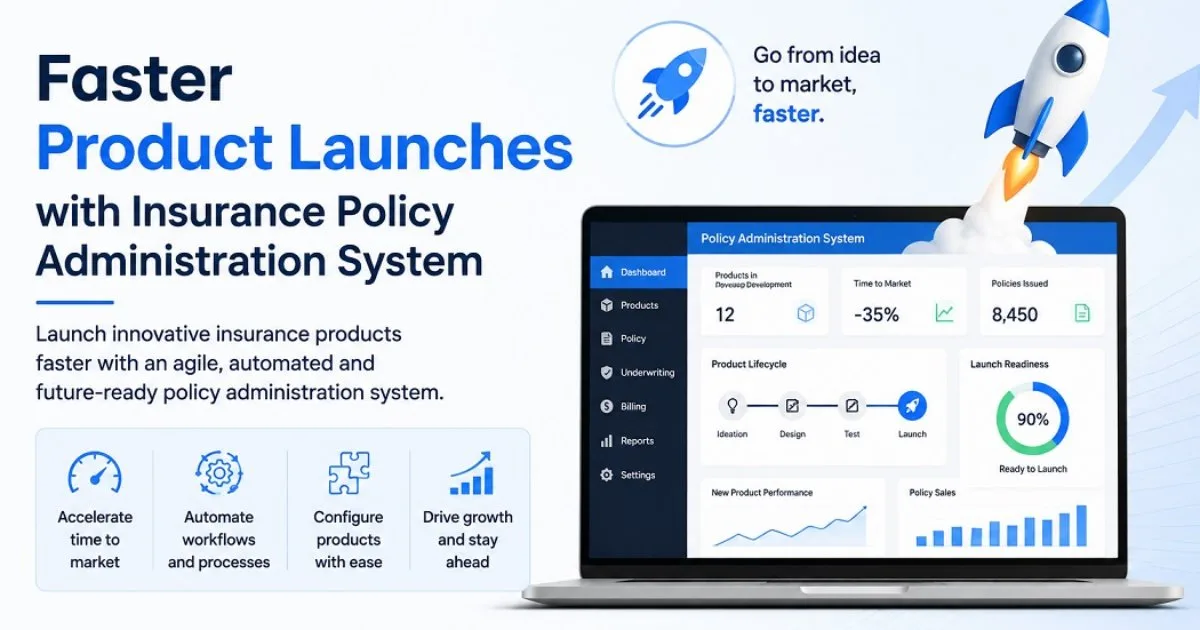

Ask a carrier why a new product took 14 months to reach the market, and the answer usually points to the core system. The platform was too old, too rigid, or too expensive to change. So, the carrier buys a modern insurance policy administration system with a shiny configuration layer, expects launches to speed up, and watches the calendar drift back toward 12 months within two release cycles.
The tooling changed. The clock did not.
Speed to market is a governance outcome long before it is a technology outcome. The carriers shipping products every quarter did not simply buy better software. They rebuilt how launch decisions get made, who owns them, and how often the core platform ships. The system is the enabler. Discipline sets the pace.
The Insurance Policy Launch Clock Runs on Approvals, Not Code
Map a real product launch end-to-end and a pattern shows up quickly. The build itself, the part everyone blames, is rarely the long pole. A rating change, a new coverage option, a revised endorsement: a competent configuration team turns these around in days. The months accumulate somewhere else.
They accumulate in the queue before actuarial pricing gets reviewed. In the wait for a compliance read on filing language. In the three-week gap between a product-owner request and the first working session with IT. In the rework loop that starts when legal sees the form for the first time at the end, not the beginning. Each handoff adds latency, and most launches cross six or seven functions before anything reaches a state filing.
See also: From Click to Completion: Accurate Web Automation with RPA
None of that is a defect in the policy administration system in insurance operations. It is a defect in how the work is coordinated around the system. A faster engine attached to the same approval chain produces the same launch date. When decisions route through unclear ownership, sequential signoffs, and committees that meet monthly, the platform spends most of its life waiting for permission to act.
This is measurable, and the carriers that improve start by measuring it. Split every launch into build time and wait time, then track the ratio across a year of releases. Most carriers discover that active work accounts for a fifth of the calendar and queues account for the rest. That single number reframes the conversation. A platform investment aimed at the fifth leaves four-fifths untouched, which is why the second modern system rarely beats the first by much. The savings live in the wait time and wait time for answers to governance.
Treating the Insurance Policy Administration System as a Product
An insurance policy administration system manages the full policy lifecycle: quoting, issuance, endorsements, renewals, billing, and cancellation, with the rating and product definitions that drive each step. Treated as a project, it gets stood up once, declared finished, and handed to a maintenance team that fields tickets. Treated as a product, it gets a roadmap, a standing budget, a dedicated team, and a release schedule that does not depend on a special initiative to move.
You may also like: Types of Inventory Management Systems
That distinction decides launch speed more than any feature comparison. A project has an end date, so investment stops the moment go-live is signed off, and the platform begins aging the next day. A product never reaches a finished state. It has an owner accountable for outcomes, a backlog ranked by business value, and a cadence that ships whether a flagship launch is in flight.
Carriers that ship quarterly treat the core platform this way on purpose. They fund it as continuing capability, staff it with people who stay long enough to understand the product lines, and measure the team on cycle time and release frequency rather than on closing a migration. The result is a platform that improves in small, frequent increments, so any single product launch rides on top of a system already in motion rather than waking a dormant one.
Where Insurance Policy Administration Projects Actually Loose Time
Consider a representative mid-size property and casualty carrier launching a new small-commercial package. The configuration work, rating tables, coverage options, and forms, takes about three weeks. The launch takes nine months.
Trace for the other eight months. The product concept sits two months in a portfolio committee that meets every four weeks and defers anything without a complete business case. Actuarial pricing waits six weeks for a shared analyst already committed to renewals. Compliance review runs sequentially after pricing, then loops back twice because filing constraints reshape the coverage design that pricing already assumed. IT scheduling adds a month because the request competes with unrelated work in the same release train. User acceptance testing slips because business testers were never assigned. Every step is reasonable on its own. Stacked in sequence, with each handoff cold, they consume the year.
Better insurance policy administration software would compress the three-week build to two. It does nothing to the eight months of waiting. The carriers that fixed this did not shorten the build. They collapsed in the queue: parallel review instead of sequential, pre-agreed pricing and filing guardrails, so most products never need a bespoke committee to pass, and a product owner empowered to say yes without convening five departments.
Building the Governance Model Before Configuring Insurance Policy Administration System
Governance discipline sounds heavier than it is. In practice, it comes down to a short list of decisions made once, written down, and honored.
- Assign a Single Accountable Product Owner: One person who owns the launch outcome and holds authority to sequence work across functions, not a committee that shares blame and owns nothing.
- Define Decision Rights up Front: Name who approves pricing, who approves filing language, and what thresholds let a change ship without escalation, so routine launches never reach a steering committee.
- Pre-Clear the Guardrails: Agree the rating bounds, coverage patterns, and compliance constraints in advance, so each product is validated against known rules instead of re-litigated from scratch.
- Fix a Release Cadence: Publish a calendar of core-platform releases and let launches board the next train rather than negotiate a custom date every time.
- Run Reviews in Parallel: Bring actuarial, compliance, and legal during design, concurrently, so rework loops shrink from weeks to a shared working session.
A carrier that settles these five points changes its launch profile before a single line of configuration is written. The work that follows is the same work, sequenced so the platform stops waiting. An experienced implementation partner will often spend the first weeks of an engagement here, on operating model and decision rights, precisely because that is where the launch calendar is actually set. Selecting a modern policy administration platform matters, and it matters most once the governance around it is settled, because the platform then executes decisions that have already been made cleanly.
The payoff shows up as outcomes the business feels, not as a technical metric. Launch cadence moves from once or twice a year to something closer to quarterly, so the product team can respond to a competitor’s move or a rate opportunity while it still matters. Pricing corrections that once waited for the next big release ship in the current cycle. Distribution partners see the carrier as a faster counterparty, which changes the products those partners bring first. None of these gains require heroics. They follow from the same platform running against a decision process that no longer stalls it.
What Modern Insurance Policy Administration Systems Can and Cannot Accelerate
Modern platforms bring real capability, and it is worth being precise about what that capability does and does not solve. Low-code and no-code product engines let business users assemble rating logic, coverage options, and workflow without a full development cycle. Component architecture lets a carrier deploy a new billing module or a digital claims flow independently, without rebuilding the core. Open application programming interfaces (APIs) connect the core to distribution portals, data enrichment, and downstream systems. Cloud delivery removes the release friction that on-premises upgrade cycles used to impose.
Each of these compresses the technical build. Not one of them decides whether the product should launch, at what price, under which filing, or in what order. That is the governance layer, and it sits above the tooling. A configuration engine in the hands of a team without clear decision rights produces faster iterations of a product still stuck in committee.
The relationship runs one direction. Good governance makes good tooling pay off, because a platform that can ship weekly finally has decisions arriving weekly to ship. Good tooling does not rescue weak governance. The best-configured policy administration systems insurance carriers can buy will still launch on the cadence of their slowest approval. Buying the platform first and hoping the operating model follows is the sequence that produces the drift back to 12-month launches.
Component architecture makes the point concrete. A carrier that can deploy a rating change without touching billing, or add a self-service portal without a core release, gains the technical freedom to ship small and often. That freedom means nothing if every small change still needs the same monthly committee approval that a full launch does. Sizing the approval to the size of the change is a governance decision, and it is the decision that lets modular tooling deliver its promised speed. A rate table tweak and a new product line should not clear the same set of gates. Carriers that grade their controls to risk spend their scarce review capacity where it counts and let low-risk changes flow.
Keeping Compliance Inside the Release Cadence with Insurance Policy Administration Software
Regulatory review is the step most often blamed for slow launches, and the one most often mishandled. Treated as a gate at the end, compliance becomes the function that says no after months of work, forcing redesign and refiling. Folded into the cadence, it becomes a set of known constraints the product is built against from day one.
The discipline here mirrors the broader argument. State filing rules, rate-change thresholds, and form requirements are stable and knowable. A carrier that encodes them as guardrails, checked continuously as configuration proceeds, catches conflicts in hours rather than discovering them in a final review. Data security and privacy controls belong in the same continuous frame: policyholder data protection, access controls, and audit trails validated as part of every release, not as a separate hardening project before go-live.
Challenges remain honest ones. Legacy data migration is genuinely hard, and dirty policy data slows any cutover regardless of governance. Skilled configuration talent is scarce. Organizational resistance to standing up a product team, with a permanent budget line, meets real friction in carriers used to funding projects. None of these vanish. But a carrier that has settled decision rights, pre-cleared its guardrails, and fixed a release cadence absorbs them as managed work rather than as the surprises that turn a nine-month launch into a fourteen-month one.
An insurance policy administration system does not fail slowly because the tooling is weak. It fails slowly because the decisions around it are slow, unclear, and sequential. Fix the governance, and the platform starts doing what its brochure always promised: shipping products on the cadence the market rewards. The carriers pulling ahead treat their core platform as a living product with an owner, a budget, and a schedule, and they staff policy administration systems for carriers as continuing capability rather than finished projects. Speed to market, in the end, is a habit an organization builds and keeps. The tooling only carries the decisions once the discipline is in place to make them quickly.






Leave a Reply