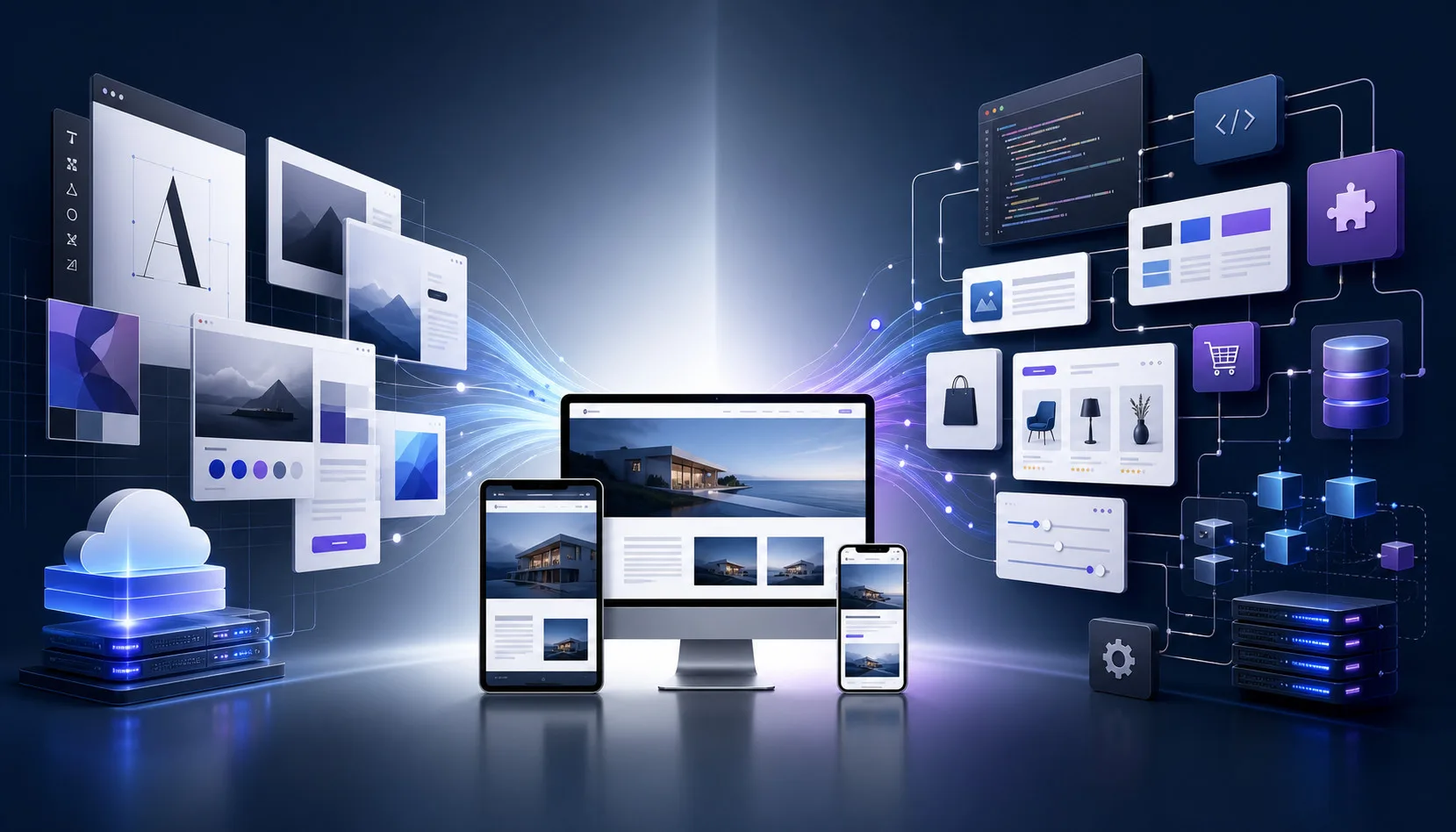

Are you confused about Webflow vs WordPress? Well, it’s normal. Because there are two kings of the hill in the website-building world today. They are WordPress and Webflow. Both systems are robust and capable of producing professional company websites, but they are developed with quite distinct mindsets. Once you understand that, selecting between WordPress and Webflow becomes a piece of cake for you.
So, read this blog to find the best website development platform for your website business.
Webflow Website Builder
Webflow isn’t like most website builders that generate ugly code and constrain your layouts. It’s more like a visual programming environment that allows designers to construct rich interactions while the platform generates the HTML, CSS, and JavaScript for you.
A professional Webflow development agency would often offer Webflow to businesses that desire exquisite user experiences, modern animations, and polished visual storytelling without wishing to manage technical server architecture manually.
Top Features of Webflow
Ability to Create Pixel-Perfect Visual Designs
With the Webflow platform, you can easily optimize your brand identity on the website without any restrictions. Designers can construct visually:
- Complex animations
- Scrolling Effects, Interactive
- Advanced typographic systems
- Flexible grids
- Dynamic visual transitions
You will create an attention-grabbing website without coding. This is what the actual Webflow website development looks like. It considerably accelerates the implementation of the design, while allowing a great degree of creative flexibility.
Faster Performance and Clean Code Architecture
One of the vital benefits of using Webflow is that it allows you to create lightweight front-end code. This performance gain is further improved:
- User Experience
- Quality of mobile browsing
- Core Web Vitals performance scores
- Search engine visibility
- Rate of Returning Visitors
Managed Hosting & Maintenance
Another big benefit of Webflow website development is the completely managed hosting infrastructure. The platform automates many of the technical things a business would otherwise need to go to a developer or hosting company to do itself.
Webflow controls:
- Web hosting SSL certificates
- Backups are automatic
- Privacy settings
- CDN performance tuning
- Updates to the platform
The simpler infrastructure means firms may spend more time on branding, marketing, and growth, instead of technical maintenance responsibilities.
This convenience is a huge operational advantage for organizations who don’t have in-house developers or technical support teams since it greatly minimizes the complexity of upkeep.
Core Limitations of Webflow
Webflow provides great flexibility in visual design and makes hosting management easy, but there are still several limits that enterprises should be aware of before fully committing to the platform.
Ecosystem Lock-In and Dependence on Platforms
Without Webflow web design services, Webflow is a closed SaaS ecosystem. Thus, you are tightly bound to the platform’s hosting environment, pricing structure, and feature constraints. Businesses do not have complete backend ownership nor unlimited server-level modification like open source solutions.
This leads to several limitations:
- Hosting cannot be simply relocated outside
- Backend functionality is still limited
- Server-side options to customize are not many
Businesses rely largely on Webflow’s roadmap and pricing policies
This rigidity might ultimately become constraining for businesses creating highly customized web applications or proprietary systems.
Limited Scalability for Complex E-Commerce
Although Webflow allows eCommerce, it is more appropriate for small to medium-sized online shops and not large-scale business-level markets.
Businesses have complex needs including:
- Multi-vendor systems
- Enterprise inventory control
- Complicated subscription structures
- Large product catalogues
Custom checkout workflows can potentially exhaust the eCommerce capabilities of the platform.
WordPress Website Builder
That’s why WordPress powers a huge percentage of the internet globally – it gives businesses full ownership, the ability to customize everything they want, and scalability like no other. In contrast to Webflow, WordPress is an open-source content management system that gives businesses total control over their source code, database, hosting provider and software architecture.
An expert web development company India typically suggests WordPress for firms that are seeking long-term expansion because the platform can adapt to practically any operational necessity or business model.
Top Benefits of Having WordPress
Complete Ownership & Control
WordPress has a big benefit in that organizations have complete control over their digital infrastructure. WordPress is self-hosted, meaning businesses can’t be bound by the ecosystem of a single provider or platform rules.
Businesses are owned by
- Files for the website
- Data bases
- Hosting environments
- Third-party integrations
- Privacy Settings
This independence provides firms with long-term flexibility and keeps them from becoming bound into a closed software environment.
Extensive Plugin Ecosystem and Functional Flexibility
WordPress has thousands of plugins and development tools that enable organizations to add advanced functionality without having to design systems from scratch.
With a professional WordPress web development company India, you will get:
- Tools for SEO optimization
- CRM software
- Membership sites
- Websites in several languages
- Learning Management Systems
- Reservation Systems
- Marketplace operations
- Analytics tools (advanced)
This ecosystem enables WordPress sites to grow and expand as your company demands evolve.
E-Commerce Scalability Without Parallel
Businesses may construct huge online storefronts that can accommodate thousands of products, extensive product filtering systems, custom payment connectors, and enterprise-level order management procedures. Many SaaS platforms may upcharge you as your stores develop, but with WordPress, you have more financial options for growing businesses.
The Main Difficulties of WordPress
Ongoing Maintenance Tasks
WordPress users need to take care of it regularly:
- Updates to plugins
- Theme updates
- Security updates
- Optimizing the database
- Backups for the Website
- Malware Defense
Without proper WordPress website maintenance, you could end up with a site that’s slow, incompatible, and unsafe for storing data.
This is why many firms work with vendors that offer professional WordPress and Webflow web design services to ensure the website remains long-lasting and high-performing.
Webflow vs WordPress Comparison
| Decision Factor | Webflow | WordPress |
| Platform Model | Closed SaaS ecosystem | Open-source CMS |
| Hosting Structure | Fully managed hosting | Self-hosted flexibility |
| Design Workflow | Visual-first development | Themes, builders, or custom code |
| Scalability | Moderate flexibility | Extremely scalable |
| Maintenance Requirements | Minimal | Requires regular management |
| SEO Flexibility | Built-in optimization tools | Advanced plugin-driven control |
| E-Commerce Capability | Suitable for smaller stores | Ideal for enterprise scaling |
| Platform Ownership | Limited ecosystem control | Full ownership and control |
Final Thoughts
As you know now, Webflow is a visual website builder and infrastructure management tool with modern design-led workflows. WordPress gives organizations complete control and freedom to customize at scale in the long run.
You can easily select which platform will offer you the kind of features you want. Based on the information, select the one you find best fits. However, if you are still looking for a platform that suits your business and are not sure which one, taking help from experts is the best way to start here. You can connect with a Webflow development agency or WordPress developers, or find an agency that offers both technologies. This is the best way to know the best platform for your business.







Leave a Reply