
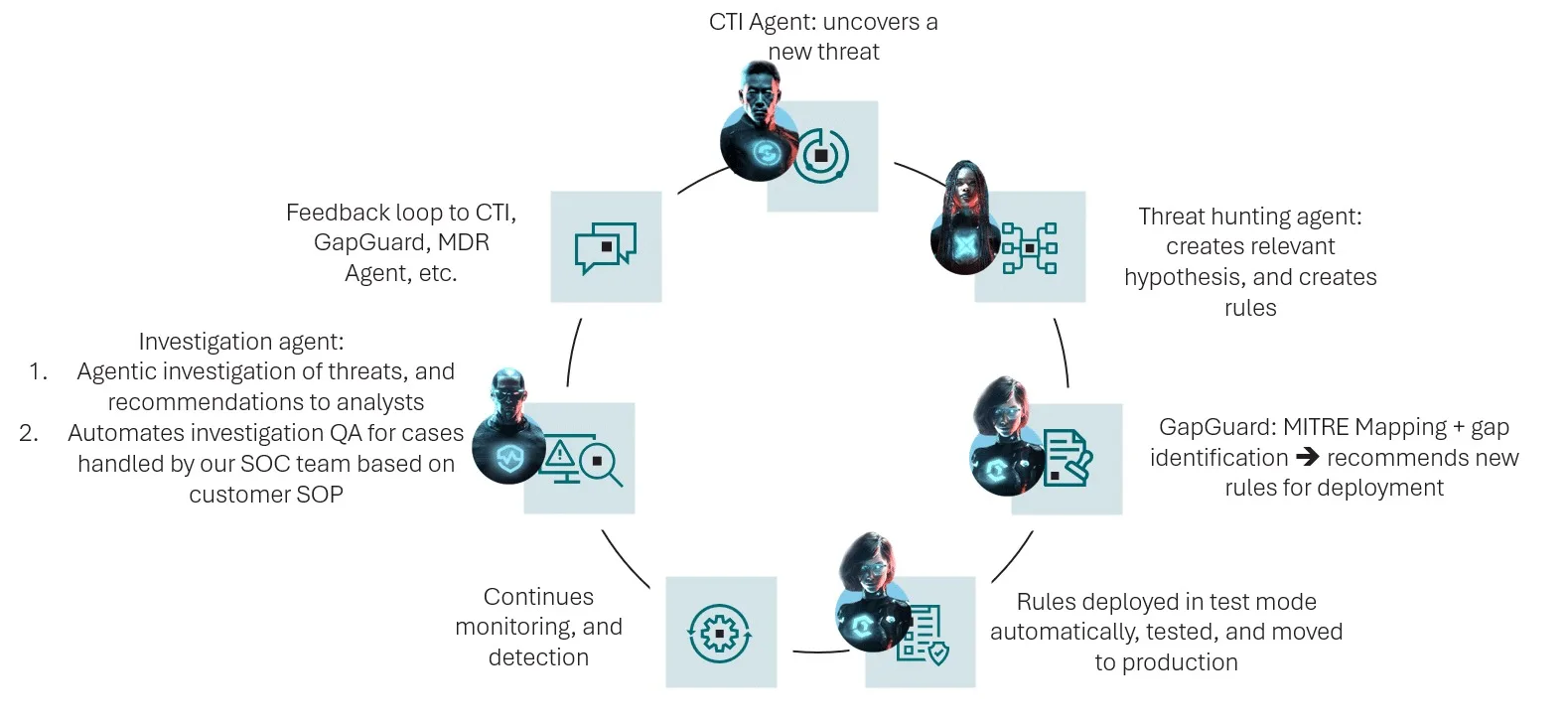

Security teams have spent years drowning in alerts. A single security operations center can generate thousands of notifications a day, and somewhere in that flood is the handful that actually matter. Analysts burn out sorting through noise, response times lag, and real threats sometimes slip through simply because there weren’t enough hours or people to catch them in time. This is the problem an agentic SOC is built to solve.
Unlike traditional security operations that rely heavily on human analysts to triage, investigate, and respond to every alert, an agentic SOC introduces autonomous AI agents into the workflow itself. These agents don’t just flag suspicious activity; they actively investigate it, correlate it with other data points, and in many cases take action, all without waiting for a human to manually work through each step. It’s a shift that’s changing what threat detection and response actually looks like inside modern security teams.
What Makes a SOC “Agentic”
The term agentic refers to AI systems capable of acting with a degree of autonomy, not just analyzing data but making decisions and carrying out multi-step tasks on their own. In a security context, this means an AI agent can receive an alert, pull related logs and context from across the network, determine whether the activity fits a known attack pattern, and either resolve it automatically or escalate it with a clear, evidence-backed recommendation.
This is a meaningful departure from the automation security teams have used in the past. Traditional automation follows rigid, pre-set rules. Agentic systems, by contrast, can reason through ambiguous situations, adapt their investigation based on what they find, and handle scenarios that weren’t explicitly programmed in advance.
Faster Triage Without Losing Accuracy
One of the biggest advantages of this approach is speed. A human analyst working through an alert might need to open several different tools, cross-reference logs, check threat intelligence feeds, and piece together a timeline before deciding whether something is a real threat. An AI agent can perform all of that correlation in seconds.
This doesn’t mean accuracy gets sacrificed for speed. Well-designed agentic systems are trained to reduce false positives by pulling in broader context before deciding, something that’s often skipped when human analysts are stretched thin and forced to make quick judgment calls. The result tends to be faster triage that’s also more consistent, since the agent applies the same thorough process to every alert rather than varying based on analyst workload or fatigue.
Autonomous Investigation Across the Alert Lifecycle
Where this model really changes day-to-day operations is in how much of the investigation process happens without direct human involvement. An agent can trace a suspicious login attempt back through related network activity, check whether the associated account shows other unusual behavior, compare the pattern against known threat indicators, and build a complete picture of what happened, all before a human analyst even opens the case.
By the time a human does get involved, much of the manual legwork is already finished. Instead of starting an investigation from scratch, analysts step in to review findings, apply judgment to edge cases, and make the final call on anything that requires human context or organizational knowledge an AI system wouldn’t have.
Reducing Alert Fatigue and Analyst Burnout
Alert fatigue is one of the most persistent problems in cybersecurity, and it has real consequences. When analysts are bombarded with alerts, many of which turn out to be false positives, the risk of missing a genuine threat goes up significantly. Burnout also drives high turnover in security teams, which creates its own security risk as institutional knowledge walks out the door.
An agentic SOC directly addresses this by filtering out the noise before it ever reaches a human. Agents handle the repetitive, low-complexity alerts that make up the bulk of daily volume, freeing analysts to focus their attention on the smaller number of genuinely complex or high-stakes incidents. This shift doesn’t just improve efficiency; it changes the day-to-day experience of working in a security operations center for the better.
Faster Response, Not Just Faster Detection
Detection is only half the equation. Response time matters just as much, since the gap between identifying a threat and containing it is often where the real damage happens. Agentic systems can be configured to take immediate, pre-approved containment actions, isolating a compromised device, disabling a suspicious account, or blocking malicious traffic, the moment a threat is confirmed with high confidence.
This kind of immediate response was previously limited to environments with fully automated playbooks for very specific, well-understood threats. Agentic systems expand that capability to a much wider range of scenarios because they can reason through context rather than relying solely on rigid, pre-written rules.
Where Human Oversight Still Matters
None of this replaces the need for skilled security analysts. Agentic systems are designed to handle scale and speed, but judgment calls involving business context, legal considerations, or ambiguous situations still benefit enormously from human expertise. The goal isn’t to remove people from the SOC; it’s to change what they spend their time on.
Effective agentic SOC models are built with clear boundaries around what agents can act on autonomously versus what requires human sign-off. High-confidence, well-understood threats might trigger automatic containment, while anything more ambiguous gets escalated with full context attached, giving analysts everything they need to make a fast, informed decision rather than starting from zero.
What This Means for the Future of Security Operations
The shift toward agentic SOC models reflects a broader reality in cybersecurity: threats are increasing in volume and sophistication faster than security teams can scale through hiring alone. Autonomous agents offer a way to close that gap without simply throwing more people at the problem.
Organizations adopting this approach are seeing measurable improvements in mean time to detect and mean time to respond, two metrics that have long been difficult to improve simultaneously. As these systems mature, the role of the human analyst is shifting from manual investigator to strategic decision-maker, someone who reviews agent-driven findings, handles the truly complex cases, and continues refining how the system responds over time.
The agentic SOC isn’t a replacement for human expertise in cybersecurity. It’s a redistribution of effort, letting machines handle the scale and repetition while people focus on the judgment calls that still require a human mind. For security teams facing an ever-growing volume of threats, that shift may be exactly what keeps them ahead instead of constantly catching up.







Leave a Reply