
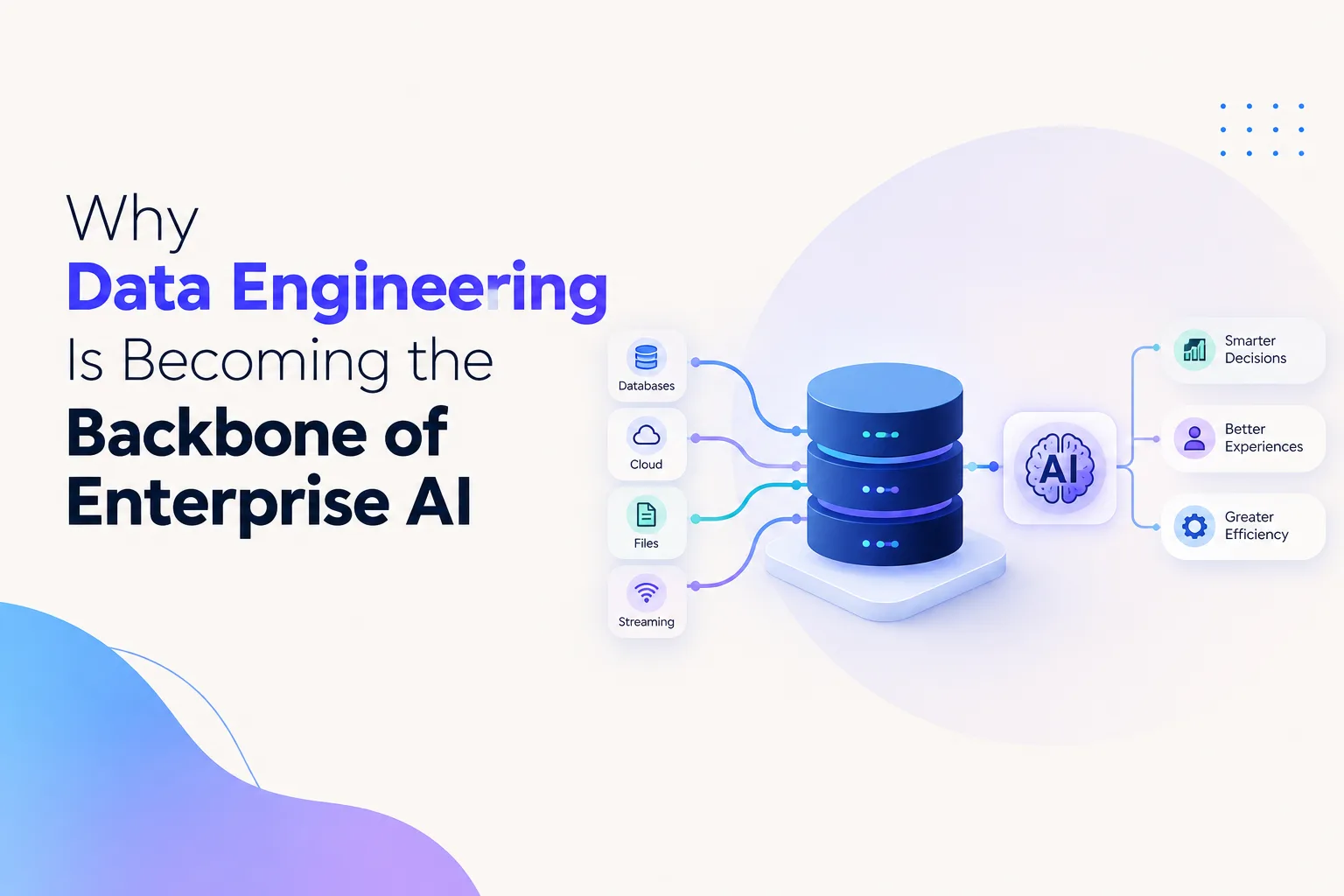

AI has moved well past the experimental stage inside most companies. It’s showing up in customer service, forecasting, fraud detection, document processing, personalization, automation, and even decisions that used to require a human in the loop. But none of that works well if the data feeding it is a mess. The model gets the credit or the blame; however, the real story is usually happening a few layers underneath, in the pipelines nobody outside the data team ever sees.
That’s why data engineering for enterprise AI has slowly turned into a strategic priority rather than a back-office function. AI systems need data that’s accurate, reachable, properly structured, governed, and available exactly when it’s needed. Skip any one of those, and even a genuinely good model starts producing answers nobody can trust.
The numbers back this up. Accenture found that only 7% of the organizations it surveyed had actually reached the level of data readiness needed to scale advanced AI. That’s a strikingly small number given how much money is being poured into AI initiatives right now, and it says a lot about where the real bottleneck sits.
The takeaway is pretty simple: you can’t treat data preparation as an afterthought anymore. It has to sit inside the core AI strategy, not bolted onto the side of it.
Why Enterprise AI Depends on Better Data
Having a lot of data doesn’t mean an AI model actually understands your business. What it needs is data that’s relevant, consistent, contextual, and maybe most importantly trustworthy.
In most enterprises, information is scattered across CRM platforms, ERP systems, cloud apps, databases, data warehouses, data lakes, internal documents, APIs, and whatever operational systems have accumulated over the years. Each of these tends to have its own formats, its own definitions of the “same” field, its own update schedule, and its own security rules.
Data engineering is what stitches all of that together and turns scattered, inconsistent information into something an AI system can actually use. A solid enterprise AI data infrastructure generally needs to handle:
- Ingesting data from both structured and unstructured sources
- Transforming and normalizing it into something consistent
- Validating quality and monitoring it on an ongoing basis
- Tracking metadata and lineage
- Enforcing governance and access controls
- Supporting real-time or near-real-time processing
- Providing scalable storage and retrieval
- Delivering data reliably to AI and analytics applications
Without this groundwork, AI teams end up spending more time hunting down and cleaning up information than actually building anything useful.
From Traditional Pipelines to AI-Ready Data
The old model of enterprise data pipelines was built around reporting and business intelligence. Collect the data, transform it, park it somewhere, and eventually push it into a dashboard someone checks once a week.
AI doesn’t play by those rules.
Modern AI systems often need fresh customer interactions, transaction records, product details, documents, conversations, images, or sensor readings within seconds, not days. Generative AI applications in particular tend to need context pulled in dynamically, rather than working off a static dataset someone prepared weeks ago.
This is why AI-ready data has become such a central idea for technology leaders. Generally, it should be:
- Accurate enough to actually support business decisions
- Consistent across every system it touches
- Accessible to the applications authorized to use it
- Rich in context and genuinely understandable
- Governed according to the organization’s own policies
- Fresh enough for whatever it’s being used for
- Traceable back to a source you can point to
IBM describes AI-ready data in a similar way as information that’s high-quality, accessible, and trusted enough to actually build AI initiatives on. The goal was never to just hoard more data. It’s about making the information a company already has genuinely useful to machines, without stripping away the context and controls that make it valuable to people in the first place.
Data Pipelines for AI Need a Different Design
The architecture behind data pipelines for AI is shifting fast, simply because AI workloads demand more than the old dashboards ever did. A pipeline feeding a weekly report might only need to refresh once or twice a day. A fraud detection system, a recommendation engine, or an intelligent assistant needs something closer to constant updates. That difference forces a handful of new engineering requirements.
- Greater data freshness. AI applications generally do better with current information, which is pushing teams toward streaming and event-driven architectures that move data from operational systems into processing and storage with much lower latency.
- Multiple data formats. AI workloads increasingly need structured and unstructured data working side by side with a customer record combined with support tickets, emails, contracts, product documentation, or past conversations, all at once.
- Stronger lineage. When an AI system gives an answer or a recommendation, someone eventually needs to know where that information actually came from. Data lineage is what allows teams to trace it back through ingestion, storage, transformation, and consumption.
- Continuous quality checks. Data quality isn’t a one-time checkbox. Source systems change, schemas drift, values shift, business processes evolve, and any of that can quietly introduce problems if nobody’s watching.
Together, these pressures are pushing enterprise data pipelines toward architectures that are more automated, more observable, and more adaptable than what most companies built a decade ago.
Data Engineering and AI Are Becoming Interdependent
The relationship between data engineering and AI used to run in one direction: engineers prepared the data, and data scientists and analysts used it. That’s changing.
AI is now being used to assist with parts of the engineering process itself, spotting anomalies, generating metadata, monitoring pipelines, suggesting transformations, even helping with documentation.
At the same time, AI applications are creating brand-new demands on data engineering teams. Take a company rolling out a retrieval-augmented generation application: it might need to process thousands of documents, keep metadata current, manage embeddings, apply the right permissions, and continuously update whatever’s been indexed. That kind of work doesn’t happen in a silo; it takes real coordination between data engineering, AI engineering, application development, security, and governance teams.
Building Scalable AI Data Infrastructure
Most enterprises don’t get to design their data environment from a blank slate. They’re working with years of accumulated technology, legacy databases, cloud platforms, third-party tools, and departmental data stores that grew organically over time.
A practical AI data infrastructure has to work with what’s already there while still laying a foundation for whatever comes next. That’s where scalable data architecture matters.
Rather than standing up a brand-new data environment for every AI project, organizations can build reusable foundations for ingestion, transformation, governance, storage, and access. A scalable architecture generally needs to account for:
- Cloud and hybrid environments
- Workload growth over time
- Storage and compute needs
- API and application integration
- Data security
- Governance
- Real-time processing
- Monitoring and observability
Get this right, and you cut out a lot of duplicated effort, making it far easier to spin up new AI use cases without rebuilding the data foundation from scratch each time.
Data Quality for AI Is a Business Issue
Bad data quality has always hurt analytics; AI just makes the damage a lot more visible, a lot faster.
Incorrect customer records, duplicate entries, outdated product details, missing values, inconsistent definitions across departments all of it can quietly skew model outputs and the automated decisions built on top of them. That makes data quality for AI less of a technical footnote and more of a genuine business issue, one that touches customer experience, operational efficiency, compliance, and trust all at once.
Organizations should be measuring quality against dimensions like:
- Accuracy
- Completeness
- Consistency
- Timeliness
- Validity
- Uniqueness
Automated testing and monitoring go a long way toward catching problems before they ever reach a downstream AI application.
Modern Data Engineering Needs Governance Built In
As AI adoption grows, so does the importance of privacy, security, and governance, and for good reason.
The data feeding an AI application might include sensitive customer information, proprietary documents, financial records, or internal business knowledge that was never meant to be widely accessible. Simply exposing that data to an AI system, without thinking it through, can create risk that didn’t exist before.
Good data management for AI includes having role-based access, classification of data, proper data retention policies, ownership, and auditability – all combined. And it would be ideal if such governance is not some kind of manual process that would slow down every AI project to a grinding halt. Governance processes work best when they are integrated within the pipelines and platforms.
What Enterprises Should Prioritize
Nobody needs to overhaul everything at once. A phased approach is usually far more realistic.
Start by figuring out which AI use cases actually matter, then map out the data those use cases depend on. From there, take an honest look at the condition, ownership, accessibility, and governance of those sources.
That usually means prioritizing:
- Data discovery — identifying the structured and unstructured sources that actually matter
- Data quality — setting up validation rules and ongoing monitoring
- Integration — connecting fragmented systems through pipelines that can be reused
- Governance — defining ownership, permissions, lineage, and policy from the start
- Architecture — building infrastructure that can grow with increasing AI workloads
- Observability — keeping an eye on pipelines, freshness, failures, and data changes
- Continuous improvement — refining the data foundation as AI use cases keep expanding
For companies that need outside expertise to design, modernize, or manage these foundations, Data Engineering Services can help carry that journey from fragmented enterprise data to something genuinely AI-ready.
The Data Foundation Will Define AI’s Next Phase
Enterprise AI is shifting. It’s no longer just about proving a model can work in a demo, it’s about making AI dependable enough to run real business operations day after day.
This makes data engineering a critical topic of discussion. While models get all the focus, it is the pipeline, the governance, the architecture, the quality measures and the availability of data that really determine whether the models can add value or just make a slide deck look good.
The enterprises putting in the work on their data foundation now will be the ones ready to support far more sophisticated AI applications down the line. Because the future of enterprise AI was never going to be built on models alone, it’s going to be built on data systems capable of feeding those models the right information, at the right time, under the right controls.







Leave a Reply