
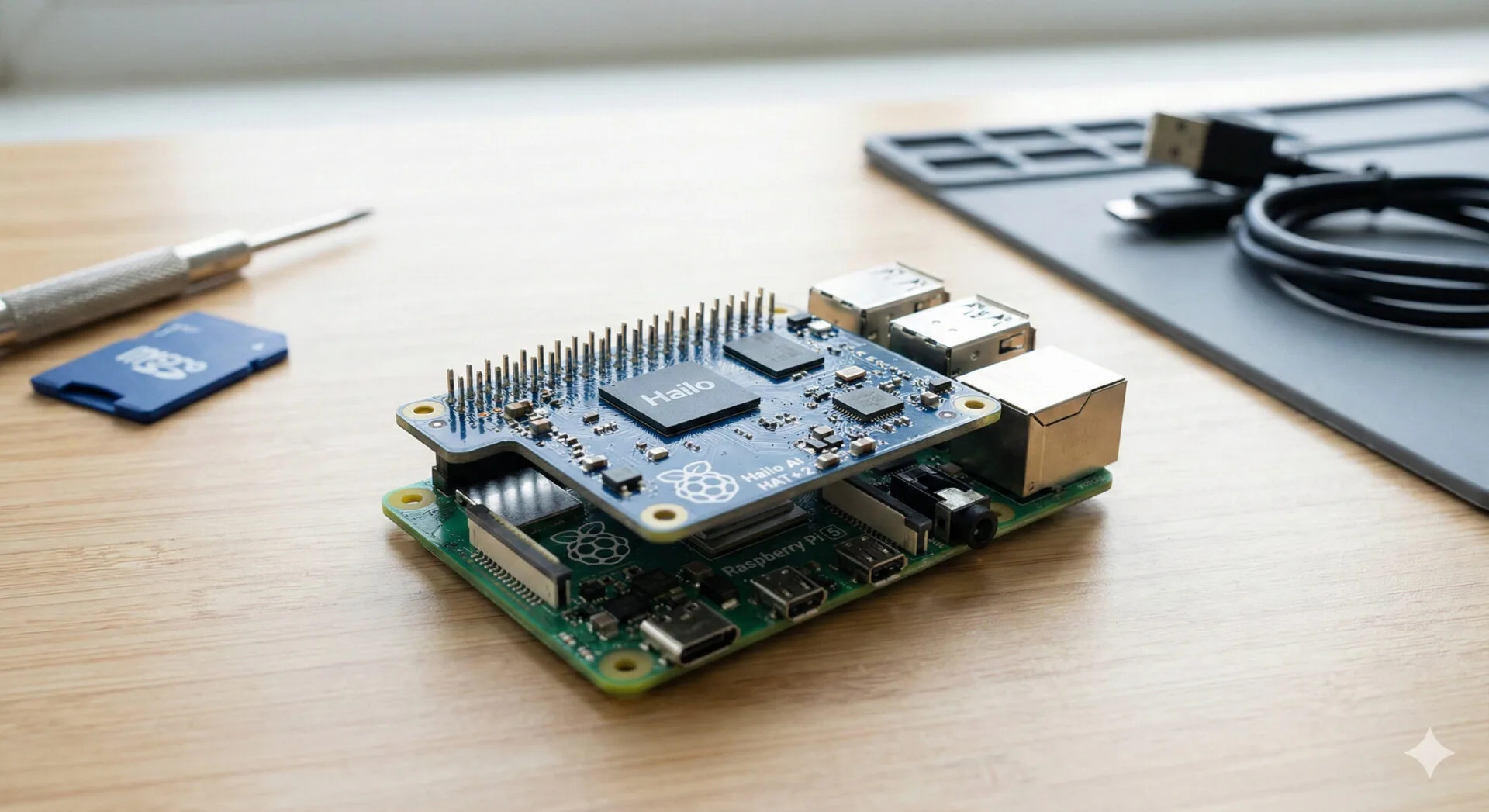

Raspberry Pi launches AI HAT+ 2: 8GB RAM add-on targets local generative AI on Pi 5
Raspberry Pi has announced a new AI-focused expansion board aimed at bringing more practical on-device generative AI to its latest single-board computer. Revealed Thursday, the AI HAT+ 2 is priced at $130 and is positioned as a more capable—if more expensive—successor to the AI HAT+ module introduced last year.
The headline change is memory: AI HAT+ 2 includes 8GB of RAM on the add-on itself, paired with a Hailo 10H AI accelerator rated at 40 TOPS (tera operations per second). The goal is to enable running more demanding AI workloads locally on the Raspberry Pi 5, rather than pushing inference to a cloud service.
Raspberry Pi’s move reflects a broader shift across the industry toward edge AI—processing data where it’s generated to reduce latency, improve privacy, and cut ongoing cloud costs. For hobbyists, developers, and product teams prototyping embedded AI, the new board could make the Pi 5 a more compelling platform for experiments like offline assistants, vision-based automation, and local text generation.
What the AI HAT+ 2 is—and why the extra RAM matters
The AI HAT+ 2 is an add-on board (a “HAT” in Raspberry Pi terminology) intended to attach to the Raspberry Pi 5 and provide dedicated AI acceleration. While the Pi 5 is a significantly faster platform than prior generations, running modern AI models—especially generative models—often runs into two constraints:
- Compute throughput (how quickly matrix-heavy operations can be performed)
- Memory capacity and bandwidth (how much model data can be held close to the accelerator)
By bundling 8GB of RAM directly on the AI add-on, Raspberry Pi is addressing a common bottleneck: even if the host system has adequate RAM, the accelerator’s performance can be limited if it must frequently shuttle tensors and model weights over slower interconnects.
In practical terms, more on-board memory can allow:
- Larger models (or larger model components) to fit in accelerator-accessible memory
- Reduced swapping/streaming of model segments
- More stable performance for multi-stage pipelines (e.g., vision encoder + language model)
That said, “running gen AI” can mean many things—from small, quantized language models to multimodal pipelines. The real-world experience will depend on model choice, quantization, toolchain support, and how workloads map to the Hailo architecture.
Hailo 10H: 40 TOPS, focused on edge inference
At the core of AI HAT+ 2 is the Hailo 10H chip, which Raspberry Pi says delivers 40 TOPS. Hailo accelerators are typically optimized for efficient inference at the edge, commonly used in embedded vision and real-time analytics.
While TOPS is an imperfect metric—it doesn’t capture memory bandwidth, sparsity behavior, precision formats, or software efficiency—it provides a rough comparative indicator that this is a meaningful step up for Pi-class deployments.
The important story for developers is less about peak TOPS and more about whether the toolchain supports:
- Popular model formats and conversion paths
- Quantization workflows
- Stable runtimes on Raspberry Pi OS
- Integration with common frameworks and pipelines
For many Raspberry Pi users, the “last mile” is software: getting a model from a notebook or repository into a performant, reliable local inference pipeline.
Price and positioning: $130 signals a more serious add-on
The $130 price tag makes AI HAT+ 2 notably more premium than many typical Pi accessories. That pricing likely reflects both the cost of a more capable accelerator and the inclusion of 8GB of RAM on the module.
The pricing also positions it as something beyond a casual add-on for blinking LEDs or basic sensors. Instead, it targets:
- Developers building edge AI prototypes
- Educators teaching practical AI deployment
- Makers building privacy-first AI projects
- Product teams evaluating low-cost compute for embedded inference
It’s also a reminder that while Raspberry Pi boards are often associated with low-cost experimentation, AI-capable hardware stacks can quickly approach the cost of small-form-factor PCs—especially once accelerators, storage, and peripherals are added.
Tech Specs
Below are the key specifications highlighted in the announcement context:
- Product: Raspberry Pi AI HAT+ 2
- Host compatibility: Raspberry Pi 5
- Accelerator: Hailo 10H
- AI performance rating: 40 TOPS
- On-board memory: 8GB RAM
- Price: $130
- Primary use case: Local (edge) inference, including generative AI workloads
For official product details and availability, readers can check the Raspberry Pi website.
What it enables: local gen AI on a Pi 5 (with caveats)
Raspberry Pi is framing AI HAT+ 2 as a way to run generative AI models locally on the Raspberry Pi 5. For many users, the appeal is straightforward:
- Lower latency: No round trips to a cloud API for each prompt or frame
- Privacy: Sensitive inputs (audio, camera feeds, text) can stay on-device
- Cost control: Avoid per-token/per-request fees for cloud inference
- Reliability: Continue operating without internet access
However, “local gen AI” on embedded devices often involves compromise. Users should expect to make choices around:
- Model size: Smaller or distilled models are more realistic
- Quantization: Lower precision formats to fit memory and boost throughput
- Task scope: Specialized tasks (summarization, classification, retrieval) may be more practical than open-ended long-form generation
- Pipeline design: Splitting workloads between CPU, GPU (if available), and the accelerator depending on what’s supported
The AI HAT+ 2’s extra RAM and higher-rated accelerator performance may widen the range of feasible models, but it won’t turn a Pi 5 into a desktop-class AI workstation.
How this fits into the Raspberry Pi ecosystem
Raspberry Pi has been steadily improving its platform’s capability for more demanding workloads, and the AI HAT+ 2 appears designed to complement that trajectory. Software support will be a major factor in adoption, especially as Raspberry Pi OS continues to evolve. For readers tracking OS-level changes, our coverage of Official Raspberry Pi OS Gets Performance Improvements and Latest Debian Updates provides context on recent performance and platform updates that can affect AI runtime stability and developer experience.
The announcement also lands in a crowded landscape of Pi-compatible and Pi-like hardware. Competing boards often differentiate on CPU/GPU performance, memory, and I/O—but AI acceleration is becoming a key battleground. For comparison, some users still consider alternatives for certain workloads, including boards like Rock Pi: $39 Hexa-Core RK3399 Raspberry Pi Clone, though accelerator availability, software maturity, and ecosystem support can weigh more heavily than raw specs.
Developer considerations: software, toolchains, and model portability
For most buyers, the most important question is: How easy is it to get models running well? In edge AI deployments, hardware capability is only half the story.
Key considerations include:
- Model conversion and compilation: Whether popular models can be converted into formats optimized for the Hailo runtime.
- Framework integration: The quality of integration with common Python workflows and edge inference stacks.
- Quantization support: Tooling to quantize models without unacceptable accuracy loss.
- Pipeline orchestration: Ability to combine camera/audio input, pre-processing, inference, and post-processing efficiently.
If Raspberry Pi and Hailo provide strong documentation, examples, and maintained packages for Raspberry Pi OS, AI HAT+ 2 could become a go-to solution for edge inference on the Pi 5.
Availability and official resources
Raspberry Pi has announced AI HAT+ 2 as a new product in its accessory lineup, targeting Raspberry Pi 5 users who want to run more capable AI workloads locally.
For official information, product documentation, and purchasing details, readers can refer to:
- Raspberry Pi (official site)
- Hailo (accelerator vendor)
What to watch next
Early adopters will be looking for benchmarks and practical demos that answer a few core questions:
- Which generative models run comfortably within the 8GB on-board memory?
- What throughput and latency can be achieved for common tasks (vision + language, transcription + summarization, etc.)?
- How mature is the software stack on Raspberry Pi OS, and how reproducible are setups across installations?
- How does the $130 cost compare to alternative edge accelerators or small PCs for similar workloads?
If the AI HAT+ 2 delivers straightforward setup and predictable performance, it could become a significant step toward making local AI on Raspberry Pi more than a novelty—especially for privacy-sensitive and offline-first projects.
Source: Read Original Article




Leave a Reply