
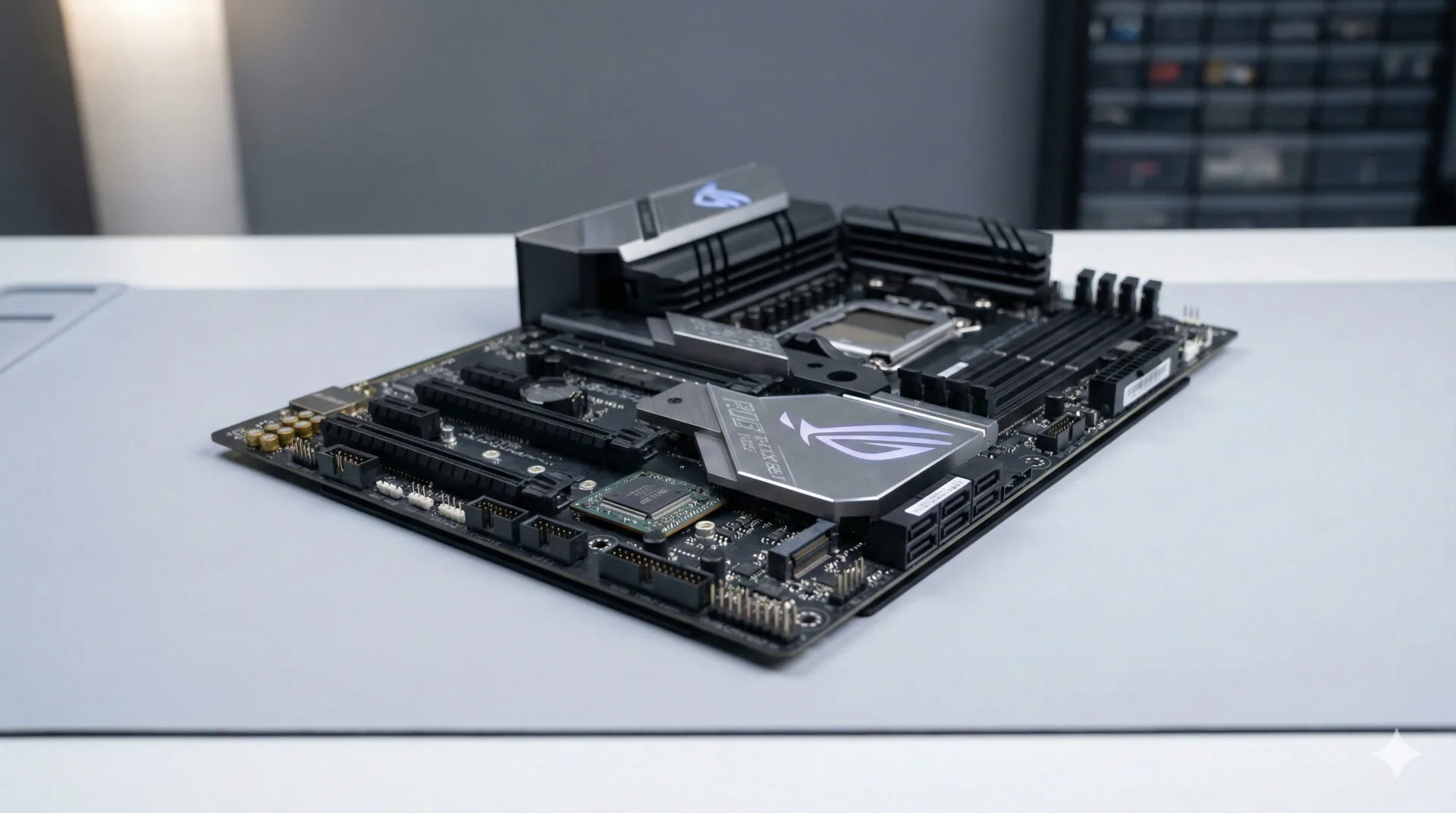

Asus expands BIOS ROM to 64MB on Strix Neo AM5 boards
Asus is increasing firmware storage on its latest AM5 motherboards, announcing that its new ROG Strix “Neo” lineup will ship with a 64MB BIOS/UEFI ROM—double the capacity found on many earlier AM5 designs. The company says the extra space is primarily intended to support future Ryzen CPU releases on the AM5 platform, but it’s also being used immediately for a more consumer-facing feature: pre-installed Wi‑Fi drivers.
The change arrives as motherboard makers appear to be anticipating the sort of BIOS-space crunch that hit the AM4 ecosystem late in its life, and it follows a similar direction from Gigabyte, which has also been moving toward larger ROM capacities on newer boards.
Which boards get the 64MB ROM upgrade
Asus says four new boards in the Strix Neo family are receiving the expanded ROM:
- ROG Strix X870E-E Gaming WiFi 7 Neo
- ROG Strix X870E-A Gaming WiFi 7 Neo
- ROG Strix B850-F Gaming WiFi 7 Neo
- ROG Strix B850-A Gaming WiFi 7 Neo
All four are ROG-branded AM5 boards that Asus previously showcased at CES 2026.
Why BIOS ROM size matters (and why AM4 made it a lesson)
BIOS/UEFI ROM capacity is easy to overlook—until it isn’t. During the AM4 era, the launch of Ryzen 5000 exposed a practical limit: many boards had insufficient ROM space to support a growing list of CPU generations while also retaining feature-rich UEFI interfaces.
When ROM space gets tight, vendors typically have to make trade-offs, such as:
- Dropping support for older CPU families to make room for newer microcode
- Simplifying the UEFI interface (removing “fancy” graphics)
- Removing non-essential firmware features (sometimes including onboard configuration tools)
To get ahead of the problem, the industry broadly transitioned from 16MB ROMs to 32MB ROMs on later AM4 400- and 500-series boards.
With AM5 still relatively early in its platform lifecycle, Asus appears to be taking a proactive approach by jumping straight to 64MB on these newer premium boards—creating more headroom for future CPU support and platform updates without the need to strip features later.
Pre-installed Wi‑Fi drivers: small feature, big convenience
While the long-term rationale is forward compatibility, Asus is also using the extra ROM space today to ship pre-installed Wi‑Fi drivers.
That matters more than it used to. A common pain point for new PC builds is the first boot into a fresh OS install—especially if:
- The system relies on Wi‑Fi (no Ethernet cable handy)
- Windows doesn’t automatically pull the correct driver
- The user needs internet access to complete setup steps
The timing is notable because Microsoft has steadily pushed Windows 11 toward an “online-first” setup flow. In many scenarios, Windows 11 installation strongly encourages (and in some editions effectively requires) a Microsoft account, which in turn can require working network connectivity early in the process. Preloaded wireless drivers can reduce the odds of being stuck at setup with no internet.
Asus isn’t alone here—Gigabyte has been moving in a similar direction—suggesting that motherboard vendors see driver availability during first boot as a growing quality-of-life differentiator.
Beyond ROM: Strix Neo’s quality-of-life upgrades
The ROM upgrade isn’t the only headline feature in the Strix Neo refresh. Asus is also highlighting several usability and layout improvements aimed at modern PC builds—particularly systems using large GPUs, multiple NVMe drives, and internal USB devices.
Q-Release for easier GPU removal
The Neo boards include Asus’ Q-Release mechanism, designed to make removing a graphics card less frustrating—especially in cramped cases where the PCIe latch is blocked by:
- Large air coolers
- AIO tubes
- Tight GPU clearances
For builders who frequently swap GPUs (reviewers, enthusiasts, or anyone troubleshooting), this can be a meaningful ergonomic upgrade.
More flexible PCIe lane/bandwidth behavior
Asus also claims an optimization that allows the primary PCIe 5.0 x16 slot to operate at full speed even with heavy NVMe population:
- Two PCIe 5.0 M.2 drives
- Plus up to three additional PCIe 4.0 M.2 SSDs
According to Asus, it achieves this by sharing PCIe bandwidth between the second M.2 slot and USB4 ports. In practical terms, this is about avoiding the common “populate this slot and your GPU drops to x8” scenario many builders worry about—though the exact behavior can depend on the board’s lane topology and the specific devices installed.
More internal USB 2.0 headers
The Neo lineup also adds three internal USB 2.0 headers, addressing a real-world issue: modern builds often include multiple internal devices that still rely on USB 2.0 headers, such as:
- AIO coolers and pump controllers
- RGB controllers
- Fan hubs
- Case accessories (sensor panels, lighting controllers)
More headers can reduce the need for internal USB hubs and simplify cable management.
Tech Specs
Key platform details (Strix Neo AM5 series)
- Socket: AMD AM5
- Chipsets (by model family):
- X870E (higher-end)
- B850 (mainstream)
- BIOS/UEFI ROM capacity: 64MB (new on these Neo models)
- Networking: Integrated Wi‑Fi 7 (as indicated by model names)
- Expansion & storage (as described by Asus):
- Primary PCIe 5.0 x16 graphics slot designed to maintain full speed with multiple NVMe devices installed
- Support for two PCIe 5.0 M.2 drives plus three PCIe 4.0 M.2 SSDs (configuration-dependent)
- Bandwidth sharing between second M.2 and USB4 for optimization
- Builder features:
- Asus Q-Release GPU retention mechanism
- Three internal USB 2.0 headers
Note: Exact lane-sharing rules and port disablement behavior can vary by board and configuration; consult the board manual for definitive tables once available.
Why this move could matter for AM5 longevity
AM5 is positioned as a long-lived platform, and history suggests that longevity can pressure firmware storage. As CPU support expands across multiple generations, vendors must include:
- CPU microcode and AGESA updates
- Memory compatibility improvements
- New device initialization modules
- Security updates and signing requirements
A larger ROM can offer more flexibility to keep compatibility broad without trimming the UEFI feature set. The comment-section speculation that BIOS ROMs could one day reach “gigabyte” territory may be hyperbole today, but the direction of travel—more devices, more features, longer support windows—does increase firmware complexity over time.
Market context: Asus’ broader hardware push
Asus’ CES-era announcements have spanned more than just motherboards. The company has also been active across GPUs and infrastructure hardware, including its gaming graphics lineup and server-focused 5G gear. For related coverage, see our internal report on ASUS Unveils Radeon RX 9070 & RX 9070 XT – High-Performance Gaming GPUs.
What to watch next
The most important unanswered questions are practical ones:
- Will 64MB ROM become standard across more Asus AM5 boards, or remain a premium differentiator?
- How broadly will pre-installed Wi‑Fi drivers be supported across Windows versions and install scenarios?
- Will other vendors follow suit and normalize 64MB as the new baseline for AM5?
For builders, the immediate takeaway is simple: if you’re buying into AM5 with an eye toward long-term CPU upgrade paths, a larger BIOS ROM is a quiet but potentially meaningful form of future-proofing—especially if it helps avoid the feature compromises that defined parts of the late AM4 era.
Smart links: Learn more about ASUS ROG hardware, AMD’s AM5 platform, and Microsoft Windows 11.
Source: Read Original Article




Leave a Reply