


NVIDIA Brings DLSS 4.5, G-SYNC Pulsar and More to CES 2026
At CES 2026, NVIDIA announced a slate of gaming and creator-facing upgrades led by DLSS 4.5, a new iteration of its AI-powered rendering stack designed to push higher frame rates while preserving (and in some cases improving) image quality. The headline additions include Dynamic Multi Frame Generation, a new 6X Multi Frame Generation mode, and a second-generation transformer model for DLSS Super Resolution.
Alongside DLSS 4.5, NVIDIA used the show to spotlight a broader ecosystem push: G-SYNC Pulsar monitors shipping this week, RTX Remix Logic for reactive mod effects, and expanded NVIDIA ACE demonstrations for AI teammates and advisors. NVIDIA also outlined new GeForce NOW updates and a set of RTX AI PC optimizations aimed at speeding up local generative AI workflows.
What’s New in DLSS 4.5
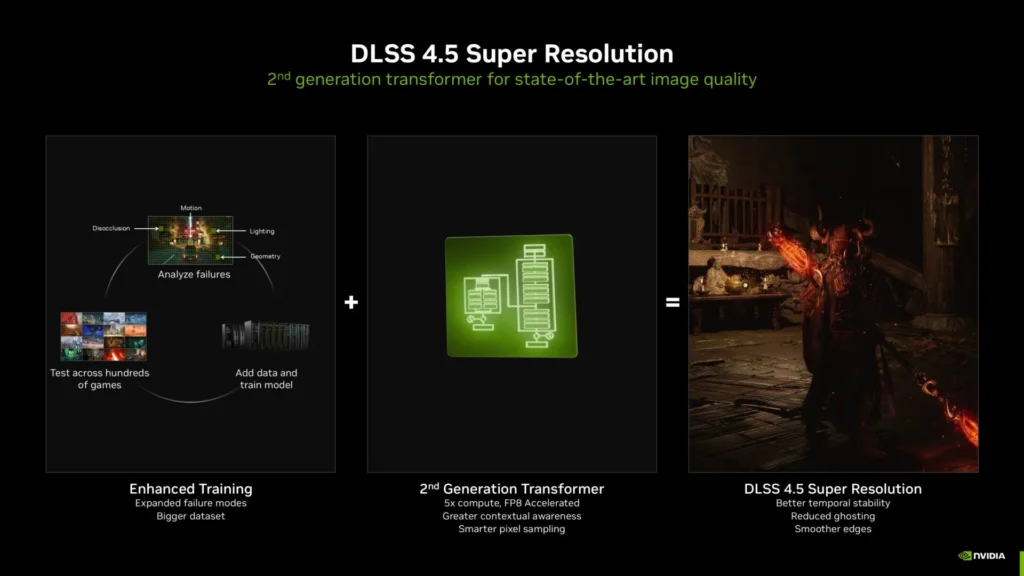
DLSS has evolved from “AI upscaling” into a layered suite that can include super resolution, ray reconstruction, and frame generation. With DLSS 4.5, NVIDIA is focusing on a specific bottleneck for high-end visuals: enabling path-traced rendering at ultra-high refresh rates without making responsiveness or clarity feel compromised.
Dynamic Multi Frame Generation and 6X Mode
The marquee feature is Dynamic Multi Frame Generation, paired with a new 6X Multi Frame Generation mode. NVIDIA says DLSS 4.5 can generate up to five additional frames per traditionally rendered frame, dynamically boosting performance. The goal is to make 240+ FPS path-traced gaming at 4K achievable on GeForce RTX 50 Series GPUs.
NVIDIA says Dynamic Multi Frame Generation and 6X Multi Frame Generation are expected in spring 2026.
Second-Generation Transformer Model for DLSS Super Resolution
DLSS 4.5 also introduces a second-generation transformer model for DLSS Super Resolution. NVIDIA positions this as a step toward “state-of-the-art” image quality across a wide range of hardware, noting it will apply to all GeForce RTX GPUs and bring improvements to over 400 games and apps.
Users can try the second-generation transformer model now via the NVIDIA App, which functions as the delivery mechanism for the updated model.
DLSS 4 Momentum: 250+ Supported Games and Apps
NVIDIA says DLSS 4 with Multi Frame Generation launched at CES last year with 75 supported titles. As of CES 2026, that number has grown to more than 250 games and apps.
The company highlighted support across major recent releases and popular titles, including:
- ARC Raiders
- Battlefield 6
- Clair Obscur: Expedition 33
- Where Winds Meet
It also announced new and upgraded titles that will support the latest RTX features, including:
- 007 First Light
- Active Matter
- DEFECT
- Phantom Blade Zero
- PRAGMATA
- Resident Evil Requiem
- Screamer
For buyers weighing GPU ecosystems, the rapid pace of game-side adoption matters as much as raw silicon. If you’re comparing feature stacks and long-term game support, see our internal guide: AMD VS NVIDIA? Which is the Best? (GPU).
Tech Specs
DLSS 4.5 (Announced at CES 2026)
- Key additions: Dynamic Multi Frame Generation; 6X Multi Frame Generation mode
- Frame generation claim: Up to 5 AI-generated frames per 1 traditionally rendered frame
- Target experience: 4K, 240+ FPS gaming with path tracing (on supported hardware)
- Hardware focus: GeForce RTX 50 Series for the 240+ FPS path-traced target; transformer Super Resolution model available for all GeForce RTX GPUs
- Availability:
- Dynamic Multi Frame Generation and 6X mode: Expected spring 2026
- Second-gen transformer model for DLSS Super Resolution: Available now via the NVIDIA App
- Ecosystem:
- DLSS 4 support: 250+ games and apps
- Second-gen transformer model reach: 400+ games and apps (as stated by NVIDIA)
G-SYNC Pulsar Monitors
- Core feature: Variable frequency backlight strobing
- Motion clarity claim: 1,000Hz+ effective motion clarity
- Additional feature: G-SYNC Ambient Adaptive Technology (built-in light sensor for automatic tuning of brightness and color temperature)
- Availability: Available this week (per NVIDIA)
RTX Remix Logic
- What it is: A logic system for making RTX Remix mods visually reactive to in-game events
- Configuration depth: 900+ configurable settings
- Classic game reach: Customization across 165+ classic games without modifying original engine code
- Availability: Later this month via the NVIDIA App
NVIDIA ACE (Gaming AI)
- Demonstrations:
- Total War: PHARAOH: AI advisor for learning systems and mechanics
- PUBG: BATTLEGROUNDS: PUBG Ally gains long-term memory; limited-time user test planned in H1 2026
GeForce NOW
- Performance tier noted: “GeForce RTX 5080-class performance” (cloud)
- New device support: Native apps for Linux and Amazon Fire TV Sticks
- Other updates: Support for throttle-and-stick peripherals; single sign-on for Gaijin titles
Why Multi Frame Generation Matters for Path Tracing
Path tracing is often described as the “end game” lighting model for real-time graphics, but it is computationally expensive. Even with powerful GPUs, pushing path tracing at high resolutions can force tradeoffs between frame rate, latency, and visual fidelity.
NVIDIA’s pitch for DLSS 4.5 is that Multi Frame Generation at higher multipliers helps close the gap between what the GPU can traditionally render and what a high-refresh display can show—particularly relevant as 4K 240Hz monitors become more common.
The key detail is that DLSS 4.5’s approach is presented as dynamic: rather than treating frame generation as a fixed multiplier, Dynamic Multi Frame Generation suggests the system can adapt behavior to conditions. NVIDIA has not, in this announcement, provided detailed technical thresholds (e.g., when it chooses a given multiplier), but it’s positioning the feature as a way to maintain smoothness without giving up advanced lighting.
G-SYNC Pulsar: A New Display Play Focused on Motion Clarity
NVIDIA’s monitor announcement is unusually direct: G-SYNC Pulsar displays are available this week, and NVIDIA is framing them as a new “gold standard” for competitive and high-motion gaming.
Variable Frequency Backlight Strobing
The core innovation NVIDIA highlights is variable frequency backlight strobing. In practical terms, strobing techniques aim to reduce perceived motion blur by controlling how the backlight illuminates frames. The challenge has historically been balancing strobing with variable refresh rate behavior and maintaining a stable, comfortable image.
NVIDIA claims Pulsar achieves over 1,000Hz effective motion clarity, which is best interpreted as a motion-clarity metric rather than a literal panel refresh rate.
Ambient Adaptive Technology
Pulsar monitors also introduce G-SYNC Ambient Adaptive Technology, leveraging a built-in light sensor so the display can automatically tune brightness and color temperature based on room lighting. It’s a quality-of-life feature, but it also signals NVIDIA’s focus on the “whole experience” surrounding high-end PC gaming: not just FPS, but consistency across different environments.
RTX Remix Logic: Reactive Visual Mods Without Engine Access
RTX Remix has been NVIDIA’s bid to modernize classic PC games with path-traced lighting and upgraded assets via a modding workflow. The new addition—RTX Remix Logic—is aimed at a long-standing limitation in modding: making visuals respond to gameplay events typically requires engine hooks or source access.
NVIDIA says Remix Logic expands what modders can do by enabling dynamic graphics effects triggered by real-time game events, using 900+ configurable settings. The company also reiterates that RTX Remix can be used across 165+ classic games without touching original engine code.
Remix Logic is expected later this month via the NVIDIA App.
NVIDIA ACE: From Scripted NPCs to AI Teammates and Advisors
NVIDIA continues to expand its NVIDIA ACE suite—tools intended to create more autonomous, conversational, and context-aware game characters.
Total War: PHARAOH AI Advisor
In Total War: PHARAOH, developer Creative Assembly is experimenting with ACE to power a dynamic advisor that can help players learn complex systems. NVIDIA says the advisor processes:
- Player prompts
- Current game state
- Data retrieved from the game’s database
The goal is real-time, context-aware guidance that stays “in-character” and aligned with the game’s lore.
PUBG Ally Gains Long-Term Memory
In PUBG: BATTLEGROUNDS, KRAFTON is adding long-term memory to “PUBG Ally,” an ACE-powered AI teammate designed to respond to commands and coordinate tactics.
NVIDIA says long-term memory allows the Ally to remember previous interactions and reference past events in its commentary. A limited-time user test is planned for H1 2026 via PUBG: BATTLEGROUNDS Arcade, initially for English, Korean, and Chinese.
GeForce NOW Expands RTX-Class Cloud Gaming to More Devices
NVIDIA also announced updates to GeForce NOW, extending cloud gaming to more platforms. The company says users can now access GeForce RTX 5080-class performance via new native apps for:
- Linux systems
- Amazon Fire TV Sticks
Additional updates include support for throttle-and-stick peripherals (useful for flight and space sims) and single sign-on for Gaijin titles.
NVIDIA also emphasized day-and-date cloud launches for upcoming titles such as 007 First Light, Active Matter, Resident Evil Requiem, and Crimson Desert.
RTX AI PCs: Local Generative AI Gets More Efficient
Beyond gaming, NVIDIA outlined several RTX AI PC improvements focused on speeding up local generative AI and reducing VRAM pressure. Highlights include:
- Up to 3x performance and 60% VRAM reduction for video and image generative AI via PyTorch-CUDA optimizations and native NVFP4/FP8 precision support in ComfyUI
- RTX Video Super Resolution integration in ComfyUI for faster 4K video generations
- NVFP8 optimizations for Lightricks’ open-weights LTX-2 audio-video model
- A blueprint for generating 4K AI video using a controlled 3D scene in Blender
- Up to 35% faster inference for small language models via Ollama and llama.cpp
- RTX acceleration for Nexa.ai’s Hyperlink video search capability
While these aren’t directly tied to DLSS 4.5, they reinforce NVIDIA’s broader strategy: using RTX hardware as a platform for both real-time graphics and local AI workloads.
What to Watch Next
The most consequential near-term questions aren’t whether DLSS 4.5 can raise frame rates—frame generation already does—but how well Dynamic Multi Frame Generation balances:
- Latency and responsiveness (especially in competitive titles)
- Frame pacing stability at very high FPS targets
- Artifact control in fast motion and complex particle-heavy scenes
Meanwhile, G-SYNC Pulsar arriving immediately is notable: display technology often lags GPU announcements, but NVIDIA is signaling that high-motion clarity and adaptive tuning are now core parts of the RTX-era experience.
For developers and modders, RTX Remix Logic could be the sleeper feature—if it truly makes reactive, event-driven visual effects accessible without engine access, it may accelerate the quality and ambition of classic-game remasters driven by the community.
Sources
- NVIDIA CES 2026 announcement blog: DLSS 4.5, path tracing, G-SYNC Pulsar, RTX Remix Logic, NVIDIA ACE, GeForce NOW, RTX AI PCs (primary source)
Source: Read Original Article




Leave a Reply