
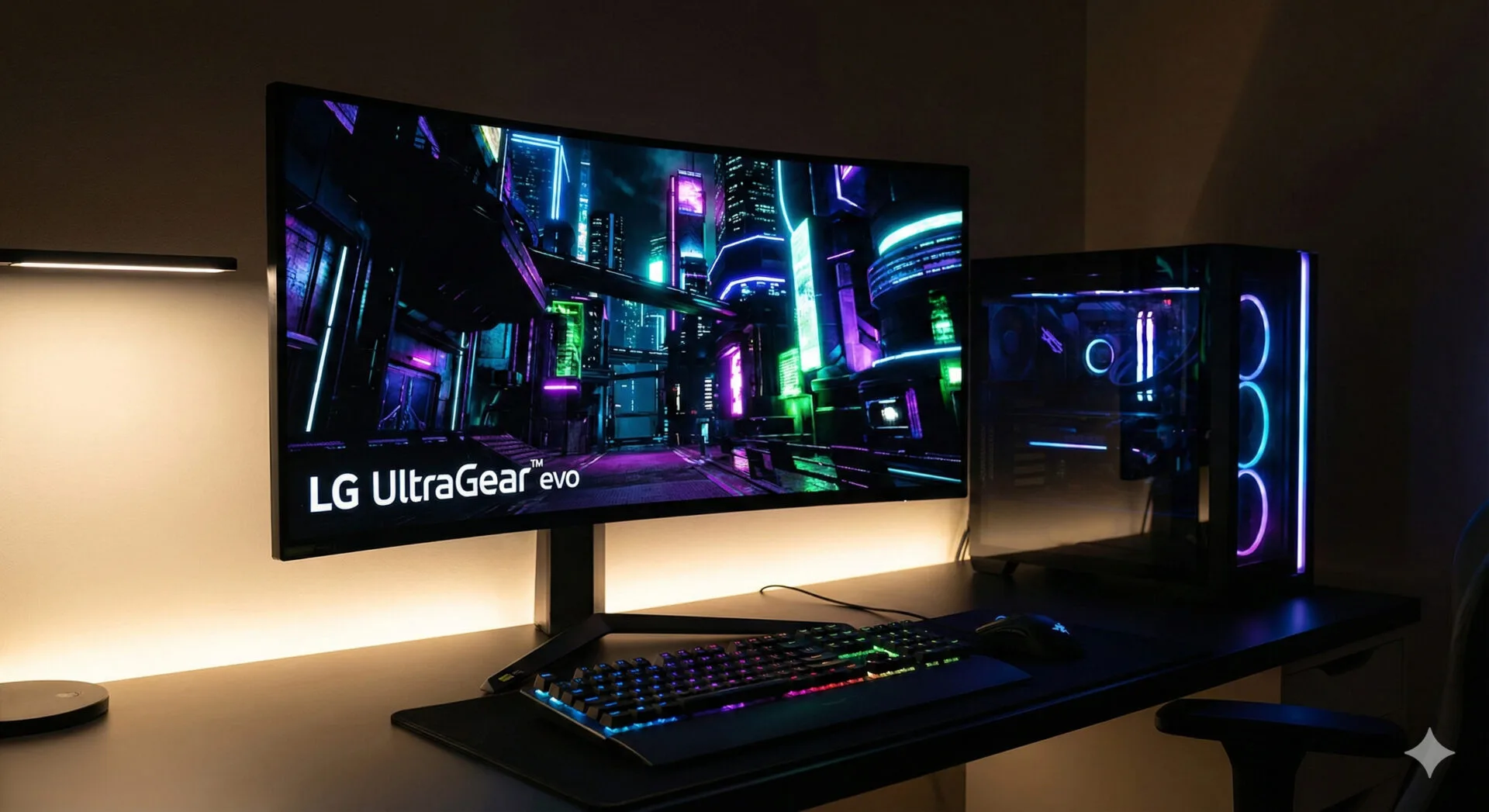

LG Bets Big on AI as It Rewrites the 5K Gaming Monitor Playbook
LG Electronics is closing out 2025 with an aggressive move in high-end PC displays. The company has announced UltraGear evo™, a new premium gaming monitor brand that aims to redefine what 5K-class gaming looks like by pairing ultra‑high resolutions with on-device AI processing.
Set to make its public debut at CES 2026, UltraGear evo launches with three flagship models:
- 39GX950B (39GX9) – a 39‑inch 5K2K OLED gaming monitor
- 27GM950B (27GM9) – a 27‑inch 5K New MiniLED monitor
- 52G930B (52G9) – a 52‑inch 5K2K, 240Hz ultra‑wide giant
All three sit above LG’s existing UltraGear range, but it’s the company’s new on‑device AI engine – powering what LG calls the world’s first 5K AI Upscaling technology – that most clearly signals where the gaming display market is headed next.
What Is UltraGear evo and Why It Matters
UltraGear evo is positioned as LG’s halo line for gaming monitors, expanding on its leadership in 5K and 5K2K displays. Where previous generations focused mainly on raw panel specs, UltraGear evo layers in AI-driven image and audio processing to address a growing pain point: not every gamer has the GPU horsepower to push native 5K at high refresh rates.
LG’s new on-device AI solution is designed to bridge that gap:
- It analyzes incoming content in real time before it hits the panel.
- It upscales lower-resolution signals to what LG describes as “5K-class clarity”.
- It adds AI Scene Optimization for visuals and AI Sound for audio.
Crucially, all of this happens on the monitor itself, not on the PC. That means there’s no additional GPU load and no need to upgrade to the latest flagship graphics card just to enjoy sharp visuals on a 5K-class screen.
The AI features are currently limited to the 39GX950B OLED and 27GM950B New MiniLED models, both of which integrate the on-device AI engine.
The Lineup at a Glance
39GX950B: 39‑Inch 5K2K OLED With 5K AI Upscaling
The UltraGear evo 39GX950B sits at the center of LG’s new strategy. It’s a 39‑inch 5K2K OLED gaming monitor that combines high pixel density with the fast response times OLED is known for.
Key characteristics include:
- Resolution & format: 5K2K (21:9), with the vertical height of a 32‑inch display
- Panel type: Primary RGB Tandem OLED
- Curvature: 1500R
- Pixel density: 142 PPI
- HDR: VESA DisplayHDR™ True Black 500
- Response time: 0.03ms (GtG)
The use of Primary RGB Tandem OLED is notable. This is the same underlying technology LG has been pushing in its latest premium displays, designed to:
- Boost brightness over conventional OLED
- Improve color accuracy
- Extend panel lifespan
On the gaming side, LG offers a Dual Mode configuration:
- 165Hz at full 5K2K resolution for cinematic, high‑fidelity gaming
- 330Hz at WFHD for esports‑style, ultra‑high refresh rate play
This duality is aimed at gamers who switch between competitive titles and more immersive, visually rich games, allowing them to prioritize either clarity or raw speed without changing displays.
The 1500R curve and 21:9 aspect ratio are tuned for immersion. LG notes that the display keeps the vertical height of a 32‑inch 16:9 monitor while stretching horizontally, giving users more peripheral content in games and extra workspace for productivity and content creation.
27GM950B: 27‑Inch 5K New MiniLED to Tackle Blooming
If the 39GX950B is about OLED’s perfect blacks, the UltraGear evo 27GM950B is LG’s answer for gamers who prefer the high brightness and punchy highlights of MiniLED – but without the typical blooming issues.
LG calls it the world’s first 5K New MiniLED gaming monitor and focuses heavily on blooming control:
- Local dimming zones: 2,304
- Backlight design: Zero Optical Distance (ZOD), which minimizes the gap between the LED backlight and the panel
By combining a dense local dimming matrix with ZOD engineering, LG aims to minimize halos around bright objects on dark backgrounds – a common criticism of many MiniLED displays.
Performance highlights include:
- Resolution: 5K (27 inches)
- Refresh rate: 165Hz at 5K, or 330Hz at QHD via Dual Mode
- Response time: 1ms (GtG)
- HDR: VESA DisplayHDR 1000
- Peak brightness: up to 1,250 nits
Those specs put the 27GM950B squarely in professional‑grade territory, not just for gaming but also for creators who demand high brightness and fine contrast control for HDR workflows.
Like the 39‑inch model, the 27GM950B includes LG’s on-device AI stack:
- 5K AI Upscaling for sharper visuals from lower‑resolution sources
- AI Scene Optimization to dynamically tune picture parameters
- AI Sound to enhance audio output in real time
52G930B: The World’s Largest 5K2K 240Hz Gaming Monitor
The third flagship, the UltraGear evo 52G930B, targets a different segment: gamers who want TV‑scale immersion without giving up monitor‑class responsiveness.
LG describes it as the world’s largest 5K2K gaming monitor, with:
- Screen size: 52 inches
- Aspect ratio: 12:9
- Curvature: 1000R
- Refresh rate: 240Hz
- HDR: VESA DisplayHDR™ 600
The 52G930B’s form factor is unusual. It offers the vertical viewing height of a 42‑inch 16:9 display, but stretches horizontally to deliver a 12:9 panoramic field of view. LG says this results in a workspace 33% wider than a standard UHD monitor.
The 1000R curve is designed to wrap around a user’s peripheral vision, aiming for a cockpit‑like feel in racing, flight, and simulation titles while also lending itself to multi‑window productivity.
World’s First 5K AI Upscaling: How It Changes the Equation
At the core of the UltraGear evo story is the 5K AI Upscaling engine, which LG is positioning as a first in the 5K monitor space. While AI upscaling is familiar in TVs and some GPUs, pushing it directly into 5K-class gaming monitors is a significant step.
On-Device AI, Not GPU‑Bound
Unlike GPU‑based scaling techniques such as NVIDIA’s DLSS or AMD’s FSR, LG’s implementation runs on the monitor hardware. The on-device AI engine:
- Receives a lower‑resolution input (for example, QHD)
- Processes it in real time using AI models
- Outputs an upscaled image that aims to approximate native 5K detail
Because this happens after the signal leaves the GPU, it:
- Reduces dependency on high‑end graphics cards
- Keeps GPU load and thermals lower
- Potentially benefits console players and cloud gaming users who can’t tweak in‑engine upscaling as deeply as PC gamers
Beyond Resolution: Scene and Sound Optimization
LG’s AI solution isn’t limited to pixel scaling. It also includes:
- AI Scene Optimization – analyzes the content type and adjusts visual parameters such as contrast, sharpness, and color tone on the fly
- AI Sound – tailors audio output based on detected content, such as emphasizing positional cues in shooters or clarity in dialogue‑heavy titles
This approach mirrors LG’s broader AI strategy across its premium display portfolio. The same philosophy underpins technologies in products like LG Micro RGB evo: LG’s Most Advanced LCD TV Powered by the Precision of OLED’s AI Processor, where AI is used to refine both picture and processing efficiency.
Tech Specs
UltraGear evo 39GX950B (39GX9) – 39″ 5K2K OLED
- Panel type: Primary RGB Tandem OLED
- Size: 39 inches
- Resolution: 5K2K, 21:9 aspect ratio
- Curvature: 1500R
- Pixel density: 142 PPI
- Refresh rates:
- 165Hz at 5K2K
- 330Hz at WFHD (Dual Mode)
- Response time: 0.03ms (GtG)
- HDR certification: VESA DisplayHDR™ True Black 500
- AI features:
- 5K AI Upscaling
- AI Scene Optimization
- AI Sound
- Target use cases: High‑end gaming, immersive ultrawide setups, HDR content consumption
UltraGear evo 27GM950B (27GM9) – 27″ 5K New MiniLED
- Panel type: New MiniLED with Zero Optical Distance
- Size: 27 inches
- Resolution: 5K
- Local dimming zones: 2,304
- Refresh rates:
- 165Hz at 5K
- 330Hz at QHD (Dual Mode)
- Response time: 1ms (GtG)
- HDR certification: VESA DisplayHDR 1000
- Peak brightness: up to 1,250 nits
- AI features:
- 5K AI Upscaling
- AI Scene Optimization
- AI Sound
- Target use cases: Competitive gaming, HDR content creation, MiniLED enthusiasts seeking reduced blooming
UltraGear evo 52G930B (52G9) – 52″ 5K2K 240Hz Ultra‑Wide
- Panel type: 5K2K panel (exact sub‑type not specified by LG)
- Size: 52 inches
- Resolution: 5K2K
- Aspect ratio: 12:9
- Curvature: 1000R
- Workspace: ~33% wider than standard UHD
- Refresh rate: 240Hz
- HDR certification: VESA DisplayHDR™ 600
- Target use cases: Large‑format immersive gaming, cockpit simulators, multi‑window productivity
AI Feature Availability
- 5K AI Upscaling, AI Scene Optimization, AI Sound:
- Available on 39GX950B and 27GM950B only
- Not currently listed for the 52G930B
Positioning Within LG’s Gaming and Display Ecosystem
The UltraGear evo announcement doesn’t stand alone. LG will also begin global sales of the UltraGear GX7 (27GX790B) on the opening day of CES 2026. That 27‑inch QHD monitor features:
- Primary RGB Tandem OLED
- 540Hz refresh rate
- A Dual Mode that can hit 720Hz at HD
Taken together, the GX7 and the UltraGear evo trio show LG segmenting its gaming line into:
- Extreme refresh rate models (like the 27GX790B) for esports
- 5K and 5K2K AI‑enhanced models (UltraGear evo) for resolution and immersion
It also reflects LG’s broader strategy of using AI to differentiate premium displays across both B2C (gaming, home entertainment) and B2B markets, including precision‑driven medical monitors.
CES 2026: How LG Plans to Showcase UltraGear evo
LG will showcase the UltraGear evo lineup at CES 2026 in two themed zones:
- A “Dream Setup” area inspired by Reddit’s gaming communities, aimed at showing how UltraGear evo fits into aspirational multi‑monitor and RGB‑heavy battlestations.
- A SimCraft‑powered racing simulation featuring the new 39‑inch GX9, highlighting the benefits of the 1500R curve, OLED contrast, and AI‑driven upscaling in high‑speed scenarios.
For LG, the event is an opportunity to tie UltraGear evo into its wider innovation narrative at CES, where it has also been promoting AI‑enhanced TVs, sound systems, and smart home devices.
What It Means for Gamers and the Display Market
The UltraGear evo launch underscores several broader trends:
- AI is moving into the display itself. Just as marketers are turning to AI‑assisted strategies to adapt to shifts in search – as explored in resources like How to Stay Ahead of Google’s Algorithm Updates with Smart SEO – display makers are embedding AI at the edge to optimize images and audio independently of the source device.
- 5K and 5K2K are becoming the new premium baseline. LG is betting that high‑end gamers will increasingly move beyond 4K, particularly in ultrawide formats.
- Hybrid performance modes are here to stay. Dual Mode configurations that trade resolution for refresh rate on the fly suggest that future monitors will be expected to serve both competitive and cinematic use cases.
For PC gamers, the most immediate impact is optionality: the ability to run games at more manageable resolutions and frame rates, while relying on the monitor’s AI to fill in detail on a 5K‑class canvas.
As always, the real test will come once reviewers can evaluate latency, artifacting, and consistency of the AI upscaling in real‑world scenarios. But with UltraGear evo, LG is clearly signaling that the next phase of the gaming monitor race won’t be fought on panel specs alone—it will be fought on intelligence built into the display itself.
Source: Read Original Article




Leave a Reply