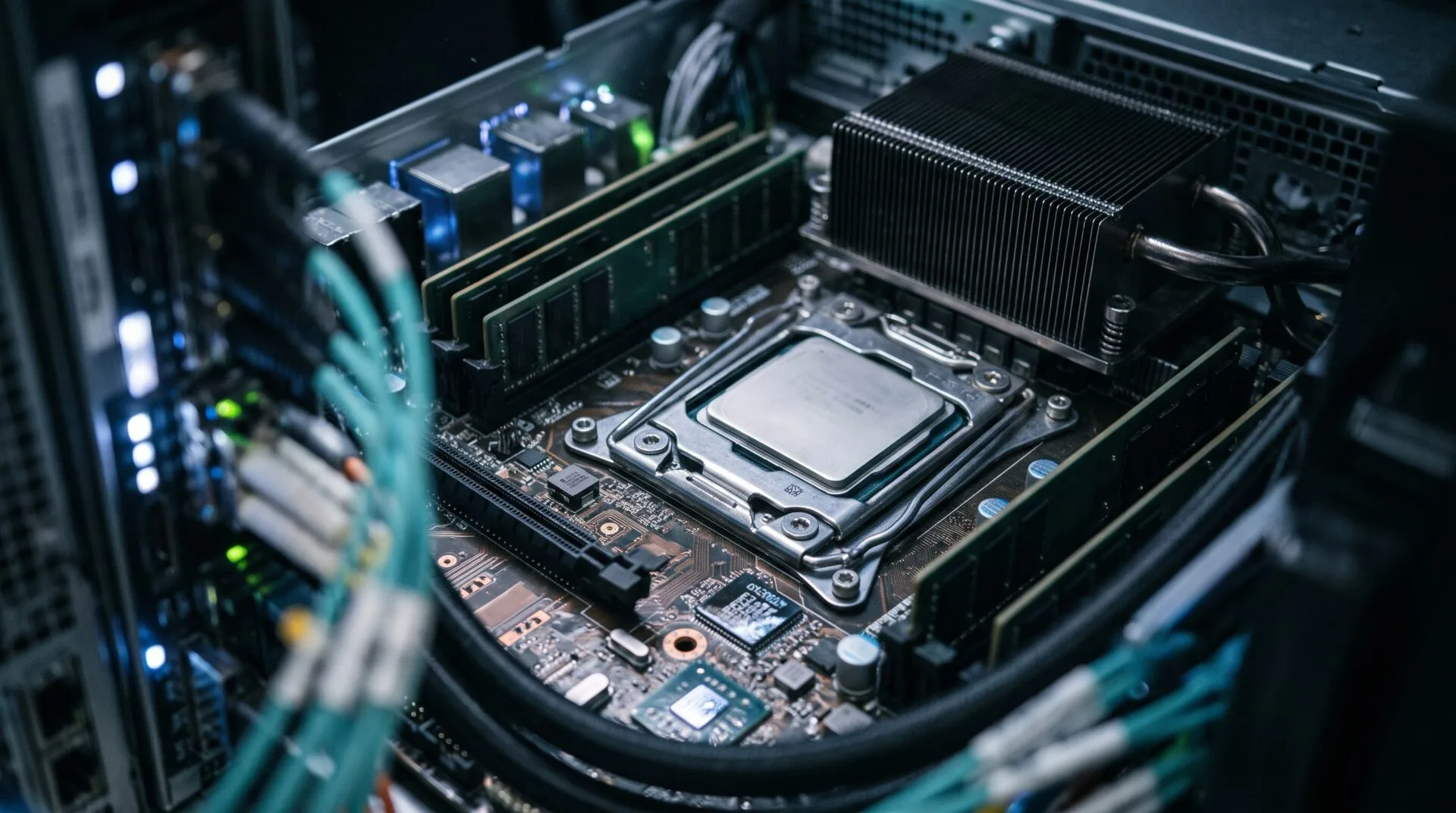
Confidential Computing is a hardware-enforced security architecture—standardized by the Linux Foundation’s Confidential Computing Consortium—that protects data while it is actively being processed in system memory (RAM) by running workloads inside CPU- and GPU-isolated Trusted Execution Environments (TEEs). Unlike traditional encryption, which only protects files on disk or across a network, Confidential Computing prevents even the cloud provider, host operating system, or hypervisor from reading active memory.
Key Takeaways
- Closes the “Data in Use” Gap: Standard cloud encryption leaves data unencrypted in RAM during computation. Confidential Computing encrypts memory in real time using keys locked inside the processor.
- Lift-and-Shift Hardware Security: Modern Confidential VMs powered by AMD SEV-SNP and Intel TDX protect existing Linux and Windows workloads without requiring developers to rewrite application code.
- Expanding to AI Accelerators: Confidential Computing now extends beyond CPUs to GPUs and interconnects, including NVIDIA Hopper, Blackwell, and Vera Rubin NVL72 architectures.
- Not Invincible: Physical hardware attacks—such as the September 2026 DDRop memory interposer exploit—prove that Confidential Computing must be paired with Zero Trust networking rather than treated as a standalone silver bullet.
The Three States of Data Security
For decades, enterprise cybersecurity has relied on protecting data in two states while accepting a glaring vulnerability in the third:
| Data State | Where It Lives | Standard Protection | Traditional Vulnerability |
|---|---|---|---|
| Data at Rest | SSDs, hard drives, cloud buckets | AES-256 disk encryption | Low (if keys are managed properly) |
| Data in Transit | Fiber cables, Wi-Fi, APIs | TLS 1.3 / HTTPS | Low (protected against eavesdropping) |
| Data in Use | System RAM and CPU registers | None (plaintext in memory) | High — exposed to compromised hypervisors, rogue admins, and memory scraping |
When you upload a medical record, financial ledger, or proprietary AI prompt to a cloud server, the server must decrypt it into RAM to process it. Confidential Computing eliminates that plaintext window by moving the trust boundary directly into the silicon.
How Hardware-Enforced Privacy Works Under the Hood
In standard cloud virtualization, a software layer called a hypervisor manages multiple virtual machines (VMs) on one physical server. The hypervisor has total visibility: it can pause a VM, dump its RAM, and inspect its CPU state.
Confidential Computing demotes the hypervisor to an untrusted resource manager using three hardware mechanisms:
- Real-Time Memory Encryption: The CPU’s memory controller automatically encrypts data as it leaves the processor for RAM and decrypts it only when it re-enters the CPU die. Encryption keys are generated inside the silicon and cannot be extracted by the host OS or cloud administrators.
- Hardware Isolation: The processor enforces strict memory-page boundaries, blocking the host OS, hypervisor, and neighboring VMs from reading or remapping a workload’s memory.
- Remote Attestation: Before a customer sends sensitive data to a cloud server, the CPU generates a cryptographically signed attestation report rooted in hardware keys burned into the chip at the factory. This lets the customer mathematically verify the exact code, firmware patch level, and hardware state before releasing decryption keys.
AMD SEV-SNP vs. Intel TDX vs. NVIDIA Confidential Computing
Early confidential computing (such as Intel SGX) forced developers to rewrite software to fit inside tiny, restrictive enclaves. Today’s data centers rely on Confidential VMs and Confidential GPUs that protect entire operating systems and AI models.
| Platform | Hardware Generation | Core Architecture | Primary Use Case |
|---|---|---|---|
| AMD SEV-SNP | 3rd Gen AMD EPYC and newer | Evolves AMD virtualization with hardware-enforced memory encryption and nested page integrity (AMD Whitepaper). | Broad Confidential VMs across Azure, Google Cloud, and AWS; paired with Azure Boost and MANA networking. |
| Intel TDX | 5th Gen Intel Xeon and newer | Clean-slate “Trust Domain” architecture isolating guest VMs from the host OS and hypervisor. | Enterprise Confidential VMs on Google Cloud (C3) and Microsoft Azure. |
| NVIDIA Confidential Computing | Hopper, Blackwell, and Vera Rubin NVL72 | Extends hardware-enforced isolation across CPU, GPU, and NVLink domains. | Private AI training, inference, and bare-metal AI deployments protecting model weights and user prompts. |
For multi-cloud engineering teams, both AMD SEV-SNP and Intel TDX achieve the same core goal: removing the cloud provider’s software stack from the trust boundary. However, because their attestation chains and verification formats differ, organizations running hybrid fleets must build verification pipelines capable of validating both hardware roots of trust.
Why Confidential Computing Is Going Mainstream Now
Two major infrastructure shifts have moved Confidential Computing from a niche banking and defense feature into standard enterprise architecture:
- Confidential AI: The largest barrier to enterprise AI adoption is data leakage. Organizations want to run proprietary code, legal contracts, and patient data through frontier models without exposing prompts or model weights to the host. By extending TEEs across GPUs and NVLink interconnects, cloud providers and AI labs can now offer hardware-verifiable private inference.
- Performance Parity: Earlier confidential VMs suffered noticeable I/O and networking overhead. Recent cloud platform upgrades—such as Microsoft Azure’s Ignite 2026 confidential computing updates pairing AMD SEV-SNP with Azure Boost, the Microsoft Azure Network Adapter (MANA), and NVMe storage support—have dramatically narrowed the performance gap between standard and confidential instances.
Who Actually Needs Confidential Computing Today?
You do not need hardware-enforced TEEs to host a public blog or an e-commerce storefront. Confidential Computing delivers the highest return for workloads where host-level access itself is a compliance or intellectual-property risk:
- Healthcare & Genomics: Running analytics or AI diagnostics on patient records across shared cloud infrastructure without violating strict privacy mandates.
- Financial Services & Multi-Party Analytics: Allowing two or more banks to pool fraud-detection data inside an attested enclave where neither party—nor the cloud host—can inspect the other’s raw records.
- Proprietary AI Deployment: Protecting billion-dollar model weights when deploying on rented GPU clusters, or guaranteeing enterprise clients that their prompts cannot be logged in memory.
- Sovereign & Regulated Cloud Workloads: Meeting strict European or government data-sovereignty rules where legal assurances from a foreign cloud vendor are no longer enough.
The Reality Check: Hardware Limits and the DDRop Attack
Confidential Computing is a massive leap forward, but silicon is not invincible.
First, neither AMD SEV-SNP nor Intel TDX completely eliminates side-channel attacks, because the untrusted host hypervisor still controls CPU scheduling and I/O timing.
Second, physical access remains a hard limit. In September 2026, researchers from KU Leuven, ETH Zurich, Durham University, and Google disclosed the DDRop attack—a hardware exploit using a physical memory interposer costing under $200 to bypass memory protection on both Intel TDX and AMD SEV-SNP servers (KU Leuven DistriNet summary).
Rather than invalidating Confidential Computing, DDRop clarifies its real-world threat model. Exploiting a physical interposer requires an attacker to physically open a locked server rack inside a guarded data center—a far higher barrier than a remote software compromise. For security architects, the rule remains clear: Confidential Computing is a layer, not a complete security strategy. It works best when combined with Zero Trust network segmentation, strict egress controls, and continuous anomaly monitoring.
Frequently Asked Questions (FAQ)
What is the difference between traditional encryption and Confidential Computing?
Traditional encryption protects data “at rest” (on storage drives) and “in transit” (over networks), but requires data to be decrypted into plaintext in RAM to be processed. Confidential Computing encrypts data in use inside hardware-isolated memory so that even the cloud provider, host OS, or hypervisor cannot read it.
Does Confidential Computing slow down applications?
Modern Confidential VMs introduce minimal CPU overhead for most workloads (typically single-digit percentages), though heavy I/O and network-intensive applications can see higher latency unless paired with hardware-offloaded networking like Azure Boost or similar cloud accelerators.
Can a cloud provider read my data inside a Confidential VM?
No. In a properly attested AMD SEV-SNP or Intel TDX virtual machine, memory encryption keys are managed strictly inside the CPU hardware. Neither the host operating system, the hypervisor, nor cloud administrators can dump or read the VM’s memory in plaintext.
Does Confidential Computing protect AI models and prompts?
Yes. When paired with GPU-level Confidential Computing (such as NVIDIA Hopper, Blackwell, or Vera Rubin NVL72), both the user’s input prompts and the AI company’s proprietary model weights remain encrypted and isolated from the host infrastructure during inference and training.
What is Remote Attestation in Confidential Computing?
Remote attestation is a cryptographic verification process where the CPU generates a signed report rooted in hardware keys burned into the chip at the factory. This allows an organization to mathematically prove the exact code, firmware patch level, and hardware state of a remote server before releasing decryption keys or sensitive data to it.
Can Confidential Computing stop physical hardware attacks?
No. While Confidential Computing defeats remote software and hypervisor-level compromises, physical access remains a boundary. Attacks like the $200 DDRop memory interposer exploit show that hardware TEEs must be combined with physical data center security, Zero Trust networking, and strict egress controls.
Do I have to rewrite my applications to use Confidential Computing?
Not anymore. While early enclave technologies like Intel SGX required major code rewrites, modern Confidential VMs (AMD SEV-SNP and Intel TDX) let you lift and shift standard Linux or Windows applications directly into hardware-encrypted memory with little to no code modification.