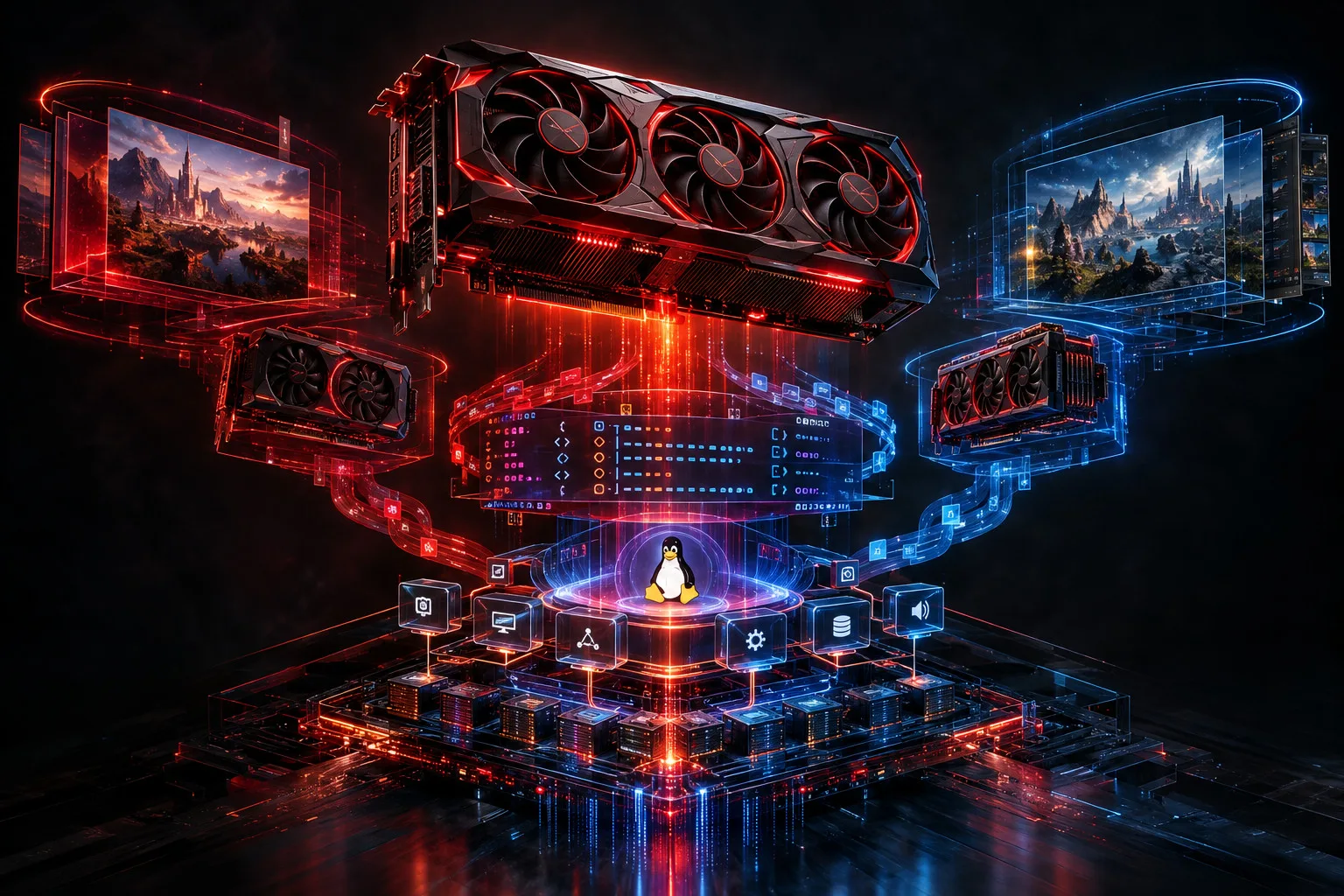
AMD’s RDNA 5 architecture is on the horizon, with full software support from Linux Kernel 7.5 anticipated soon. This development signals a crucial milestone for AMD as it prepares to launch RDNA 5, expected in the latter half of 2027. The integration of RDNA 5 support within the Linux kernel emphasizes the growing importance of open-source ecosystems in modern computing.
Read also: Kali Linux 2025.4: New Tools, Enhanced Wayland, and More
RDNA 5 and Linux Kernel Integration
The integration of RDNA 5 within Linux Kernel 7.5 represents a pivotal step in aligning AMD’s next-generation graphics architecture with the open-source community. In early November, AMD released a series of patches aimed at adding GFX13 support to the AMDGPU driver. These updates are crucial for establishing a foundation that ensures RDNA 5’s capabilities are fully leveraged on Linux-based systems.
The GFX13 identifier refers to AMD’s internal codename for the RDNA 5 architecture. This move follows AMD’s strategy of enabling software support well before hardware availability, a practice that helps refine and optimize the ecosystem ahead of the consumer launch. The early integration of RDNA 5 into the Linux kernel not only benefits developers by providing a stable environment for testing and optimization but also ensures that end-users will have access to a mature software stack upon the hardware’s release.
The Technical Leap: GFX 13.0.1 and GFX 13.0.4
AMD’s focus on GFX 13.0.1 and GFX 13.0.4 suggests the introduction of at least two distinct graphics IP configurations. Although specific GPU models associated with these configurations remain undisclosed, the anticipation surrounding RDNA 5 is palpable within the industry. These identifiers hint at significant advancements over the RDNA 4 architecture, promising enhancements in performance and efficiency.
The GFX 13.0.1 and 13.0.4 configurations indicate AMD’s commitment to delivering diverse solutions tailored to different segments of the market. This approach could potentially cater to both high-performance and power-efficient needs, expanding AMD’s reach across various consumer and professional applications.
Display Core Next 6 Integration
Among the notable advancements is the integration of Display Core Next 6 (DCN6), a display engine exclusive to RDNA 5. DCN6 is expected to deliver improved display management and enhanced visual fidelity, complementing the architectural improvements of RDNA 5. The inclusion of DCN6 signifies AMD’s focus on pushing the envelope in terms of graphical output quality, which is crucial for applications ranging from gaming to professional creative work.
Open-Source Driver Support
In addition to kernel integration, AMD is ensuring that open-source driver support is robust from the outset. Both the RadeonSI OpenGL and RADV Vulkan drivers in the Mesa 3D Graphics Library are receiving updates to accommodate RDNA 5. This proactive approach guarantees that Linux users will have access to optimized drivers, maximizing the performance potential of RDNA 5 GPUs upon release.
The collaboration with the open-source community reflects AMD’s strategy to foster a wide adoption of its technologies. By ensuring that open-source drivers are ready at launch, AMD not only enhances the Linux gaming experience but also supports developers who rely on these drivers for creating and optimizing applications.
Anticipated Impact on the Market
The impending release of RDNA 5 is expected to have a significant impact on the GPU market. With its advanced architecture and robust software support, RDNA 5 could potentially set new benchmarks in terms of performance and efficiency. This release is particularly important as it comes at a time when the demand for high-performance computing solutions is growing, driven by advancements in AI, gaming, and professional graphics applications.
AMD’s strategy of aligning its hardware and software releases with the open-source community could also influence how competitors approach their own product launches. The emphasis on open-source support could lead to increased competition in this space, ultimately benefiting consumers with more choices and potentially lower prices.
FAQ Section
What is RDNA 5?
RDNA 5 is AMD’s upcoming graphics architecture, succeeding RDNA 4. It is expected to offer significant improvements in performance and efficiency.
When will RDNA 5 be available?
While software support is anticipated with Linux Kernel 7.5, the hardware release is rumored for the second half of 2027.
What is the significance of GFX13?
GFX13 is the internal codename for RDNA 5, indicating the architecture’s new capabilities and configurations.
What are RadeonSI and RADV?
RadeonSI and RADV are open-source graphics drivers in the Mesa library that support OpenGL and Vulkan APIs, respectively, ensuring compatibility and performance on Linux systems.
Tech Specs
- Architecture: RDNA 5 (GFX13)
- Kernel Support: Linux Kernel 7.5
- Display Engine: Display Core Next 6 (DCN6)
- Driver Support: AMDGPU, RadeonSI OpenGL, RADV Vulkan
This strategic alignment with Linux ensures that AMD’s RDNA 5 will have a well-supported launch, providing a solid foundation for developers and users alike. As the release date approaches, the tech community eagerly anticipates the innovations RDNA 5 will bring to the table.
Source: TechPowerUp