
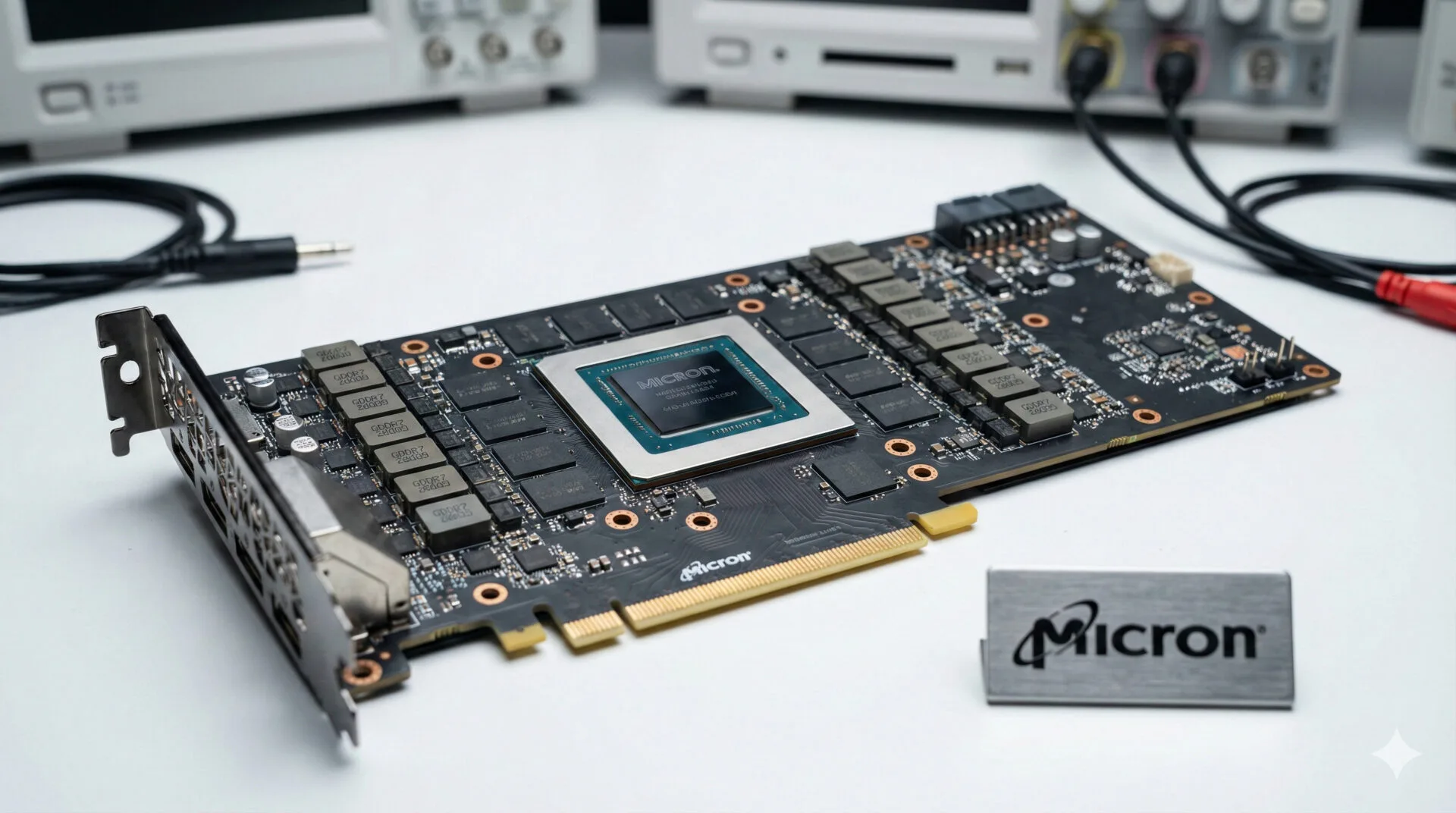

Micron officially enters the 3GB GDDR7 era
Micron has finally joined the fast-growing 3GB GDDR7 club, announcing new 3GB GDDR7 memory ICs rated for 36 Gbps. That matters more than it might sound at first glance: 3GB dies are a key building block for higher-VRAM graphics cards without resorting to extremely wide memory buses or oddball capacity configurations.
The headline is simple: Micron’s 3GB GDDR7 is quicker than the first wave of GDDR7 (32 Gbps-class parts), but it still lags behind the top-end speed claims coming from Samsung and SK hynix.
This announcement also gives GPU makers another supplier option at a time when the memory ecosystem is being pulled in multiple directions—consumer graphics, data center accelerators, and the ongoing race for high-margin HBM capacity.
The big numbers: 36 Gbps vs the competition
Micron says its new 3GB GDDR7 ICs run at 36 Gbps, which is a 12.5% uplift over early 32 Gbps GDDR7 parts.
But the competitive landscape is already spicy:
- Samsung has touted GDDR7 that can reach up to 42.5 Gbps.
- SK hynix has demonstrated GDDR7 scaling up to 40 Gbps, while also working toward even faster future variants (with talk reaching as high as 48 Gbps in the pipeline).
So yes—Micron is arriving with a strong product, but not the fastest spec sheet in the room.
Still, raw peak data rate isn’t the only thing that determines what ends up inside real GPUs. Volume availability, binning, yields, power behavior, thermals, and vendor qualification cycles tend to decide what actually ships.
Why 3GB GDDR7 matters (even if you don’t care about memory chips)
Historically, GPU VRAM capacities are constrained by how memory chips map onto a given bus width. A quick mental model:
- A 256-bit GPU typically uses 8 memory chips (each 32-bit).
- A 384-bit GPU typically uses 12 memory chips.
If each chip is 2GB, you get common totals like 16GB (8×2GB) or 24GB (12×2GB). But with 3GB chips, those same layouts become:
- 256-bit bus: 24GB (8×3GB)
- 384-bit bus: 36GB (12×3GB)
That’s a huge deal for:
- Workstation cards that need large VRAM pools
- Laptop flagships where board space is limited
- Potential “Super” refreshes that need an easy, marketable upgrade (more VRAM) without redesigning the entire GPU
In other words: 3GB GDDR7 is a capacity lever, not just a speed lever.
Today’s GPUs don’t even use 40+ Gbps GDDR7—yet
Here’s the most important context: current shipping GPUs aren’t anywhere near 40 Gbps on their memory settings.
As referenced in the source reporting, some of the highest real-world GDDR7 transfer speeds on current Nvidia cards include:
- RTX 5080 at 30 Gbps
- RTX 5090 at 28 Gbps
Enthusiasts have shown memory overclocking results on select models (including RTX 5070 Ti and RTX 5090D) pushing into the mid-30 Gbps range on Samsung and SK hynix chips—around 34 Gbps in some cases.
That reality changes how you should read Micron’s 36 Gbps number:
- It’s not a bottleneck for today’s shipping cards.
- It’s headroom for future SKUs, board partner OC models, and next-gen designs.
- It’s also a signal that Micron is ready to be a serious supplier for the 3GB GDDR7 configurations GPU vendors seem to be moving toward.
Why Micron’s “slower” 36 Gbps still matters
If Samsung and SK hynix can go faster, why should anyone care about Micron’s 36 Gbps?
Supply chain resilience (the underrated win)
Adding a third source for 3GB GDDR7 is a practical advantage for GPU makers—especially NVIDIA and any partner building high-volume SKUs.
Even if a GPU design doesn’t need the absolute fastest bin, it does need:
- predictable supply
- stable pricing
- qualification across multiple vendors
- flexibility to swap memory sources without delaying product launches
In the current climate—where memory capacity can be diverted toward higher-margin products—having another qualified supplier can be the difference between a paper launch and cards on shelves.
It can enable VRAM bumps without a new GPU die
If Nvidia decides to roll out an RTX 50 “Super” refresh, 3GB modules are a clean way to raise VRAM on familiar bus widths.
The source notes that the only Nvidia GPUs currently using 3GB GDDR7 include:
- the laptop variant of the RTX 5090
- the RTX Pro 6000 Blackwell workstation GPU
But rumors have long pointed to broader adoption of 3GB modules in potential refreshes—exactly because it’s a simple lever to pull.
Performance isn’t just data rate
Even when two chips share a “Gbps” rating, board-level outcomes depend on:
- signal integrity at target clocks
- thermals under load
- power draw and voltage requirements
- error margins and stability
A 36 Gbps part that’s efficient and plentiful can be more valuable than a 42.5 Gbps part that’s scarce, hot, or expensive.
Tech Specs
Below is a clear snapshot of what’s been stated or referenced around these parts and the current GPU landscape.
Micron 3GB GDDR7 (newly announced)
- Memory type: GDDR7
- Density per IC: 3GB
- Rated data rate: 36 Gbps
- Target use: discrete GPUs and professional/workstation graphics (via board partners and GPU OEMs)
Competitive GDDR7 speed positioning (as cited)
- Samsung GDDR7: up to 42.5 Gbps
- SK hynix GDDR7: up to 40 Gbps (with faster roadmap targets discussed)
Current Nvidia GDDR7 shipping/observed speeds (as cited)
- RTX 5080: 30 Gbps
- RTX 5090: 28 Gbps
- OC examples (select models): around 34 Gbps on some Samsung/SK hynix-equipped cards
Note: Actual memory speed and capacity on retail cards varies by SKU, board partner design, BIOS limits, and memory vendor qualification.
What this could mean for RTX 50 Super and next-gen Radeon
Micron’s timing is interesting because it aligns with a period where GPU makers can:
- refresh existing architectures with more VRAM
- maintain similar board layouts
- market tangible improvements without a full generational leap
If an RTX 50 Super lineup materializes, 3GB GDDR7 makes it easier to create “obvious upgrades” (capacity bumps) across multiple tiers. Meanwhile, future AMD Radeon designs could also take advantage of 3GB modules to hit cleaner capacity targets.
And if next-gen GPUs (RTX 60 series and beyond) decide to push memory clocks harder, Micron’s 36 Gbps bin becomes a baseline—while Samsung and SK hynix fight for the absolute top speed crown.
The bigger memory industry tension: GDDR vs HBM
One of the recurring concerns in enthusiast circles is whether memory makers will prioritize HBM production over consumer-focused GDDR, especially when data center accelerators can command premium margins.
Micron’s move can be read two ways:
- Optimistic take: Micron is investing in GDDR7 density options because GPU demand is real and long-lived.
- Cautious take: GDDR7 progress may be paced by what’s necessary for current GPU generations, while the industry’s top capital and capacity expansion goes toward HBM.
Either way, a third supplier for 3GB GDDR7 is a net positive for availability—particularly when demand spikes.
What to watch next
A few near-term signals will tell us how impactful Micron’s 3GB GDDR7 is:
- Design wins: Which GPUs (consumer, laptop, workstation) qualify Micron’s 3GB chips first?
- Real shipping speeds: Do we see Micron-based boards shipping near 36 Gbps, or are they binned lower to match existing designs?
- VRAM capacity shifts: Do mid- and high-end cards normalize higher VRAM (e.g., 18GB/24GB/36GB) using 3GB ICs?
- Pricing and supply: Does an additional supplier reduce volatility for AIB partners and OEMs?
And if you’re the kind of reader who likes practical tech guides alongside bleeding-edge silicon news, this is also a good moment to revisit everyday upgrades—like cleaning up your workspace and PC area to keep thermals in check. Our internal guide, How to Choose the Perfect Handheld Vacuum Cleaner, is a surprisingly useful companion to any build season.
Bottom line
Micron’s 3GB GDDR7 at 36 Gbps isn’t about beating Samsung or SK hynix in a pure speed showdown—at least not yet. It’s about joining the density tier that enables better VRAM configurations, giving GPU makers another qualified supplier, and laying groundwork for refreshes and next-gen designs.
Given that today’s shipping GDDR7 GPUs are still running well below 36 Gbps in many cases, Micron’s new modules look less like “late to the party” and more like “arriving right when the guest list gets bigger.”
Source: Read Original Article




Leave a Reply